Episode 17: What makes a good AI infrastructure engineer?
Published: Thursday, Jan 15, 2026 • Duration: 73 minutes • Season 1
Download MP3 | Watch on YouTube
https://docs.google.com/document/d/1zoc-0L1o1Cyxtgatb9fN_ZGBGbshZIb9BTzwEj0C4Gc/edit?usp=sharing
summarize "https://youtu.be/ij20sZmxC7k" --timestamps --slides
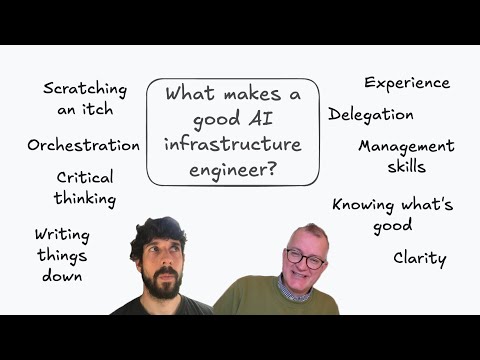
Kai Hendry and Vincent discuss the evolving landscape of AI infrastructure engineering, focusing on how large language models (LLMs) are shifting the definition of seniority from manual coding to orchestration and strategic thinking. They explore recent industry milestones, such as the rapid development of complex software using agent swarms, and contrast the developer experiences of various infrastructure-as-code tools. The conversation highlights the friction between rapid AI-assisted delivery and the long-term maintenance of platform dependencies, offering a perspective on how engineers must adapt to remain effective as “managers” of AI agents.

Agentic workflows and task delegation
The discussion begins with a critique of current AI agent frameworks like Ralph, which aim to move beyond simple sequential task completion. Unlike traditional planning tools where a human defines a set of steps for an AI to follow, agentic frameworks focus on delegating the generation of the tasks themselves. This allows agents to fetch work, insert new tasks dynamically, and operate in parallel loops. The hosts note that while this approach is powerful, it requires a shift in how engineers interact with tools, moving away from micro-managing code toward managing the “loop” of work. They also touch on the recent trend of “reaction” content in the developer community, specifically regarding how major AI labs are beginning to restrict third-party access to their subscription plans, forcing a more direct relationship between developers and model providers.

Rapid development and browser engines
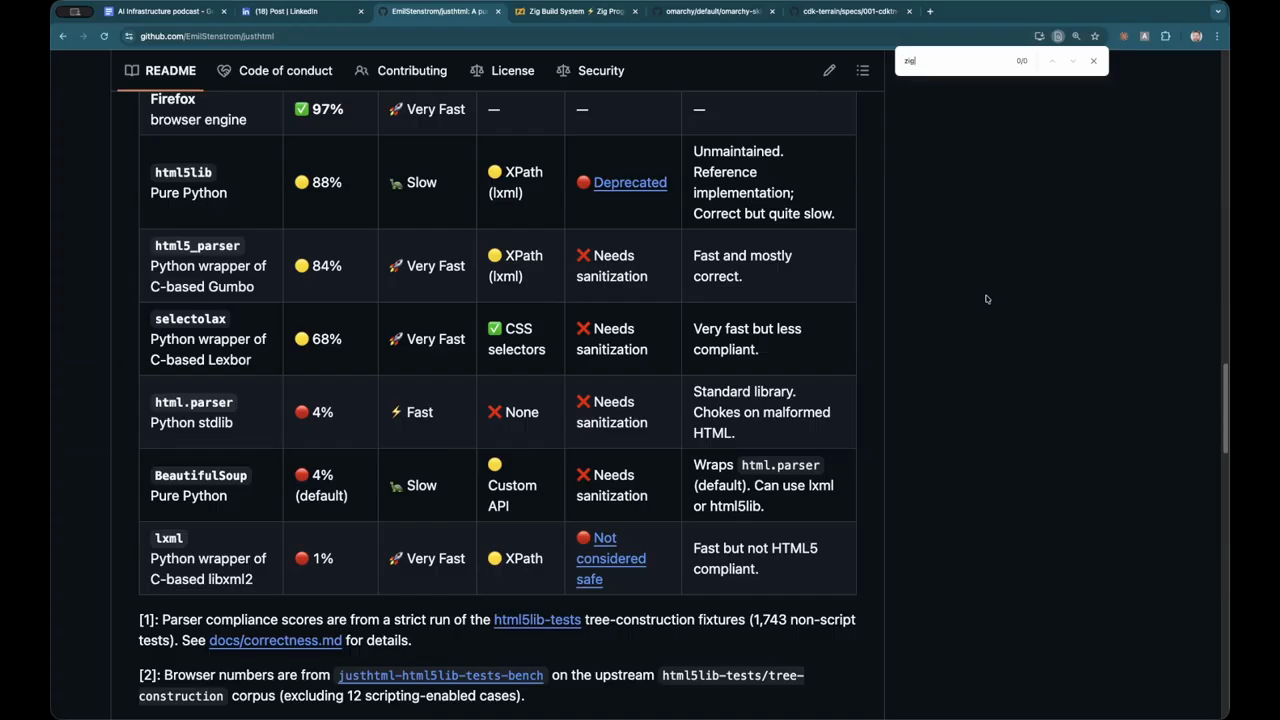
A major theme is the unprecedented speed of development enabled by AI agent swarms. The team behind the Cursor editor recently built a browser engine in Rust, totaling approximately 3 million lines of code, in just one and a half weeks. While this is significantly smaller than the 31 million lines in Firefox, the fact that it functions as a rendering engine demonstrates the disruptive potential of AI. Similarly, an AI-generated HTML parser was created by feeding the HTML specification into a model, resulting in 3,000 lines of code that passed all standard test suites. This capability suggests that traditional software-as-a-service (SaaS) models, like Jira, may face disruption as it becomes trivial for small teams or individuals to generate custom, complex applications from scratch. Seniority is determined not by how much you code but by how well you can orchestrate and delegate.
Maintaining quality in the AI era
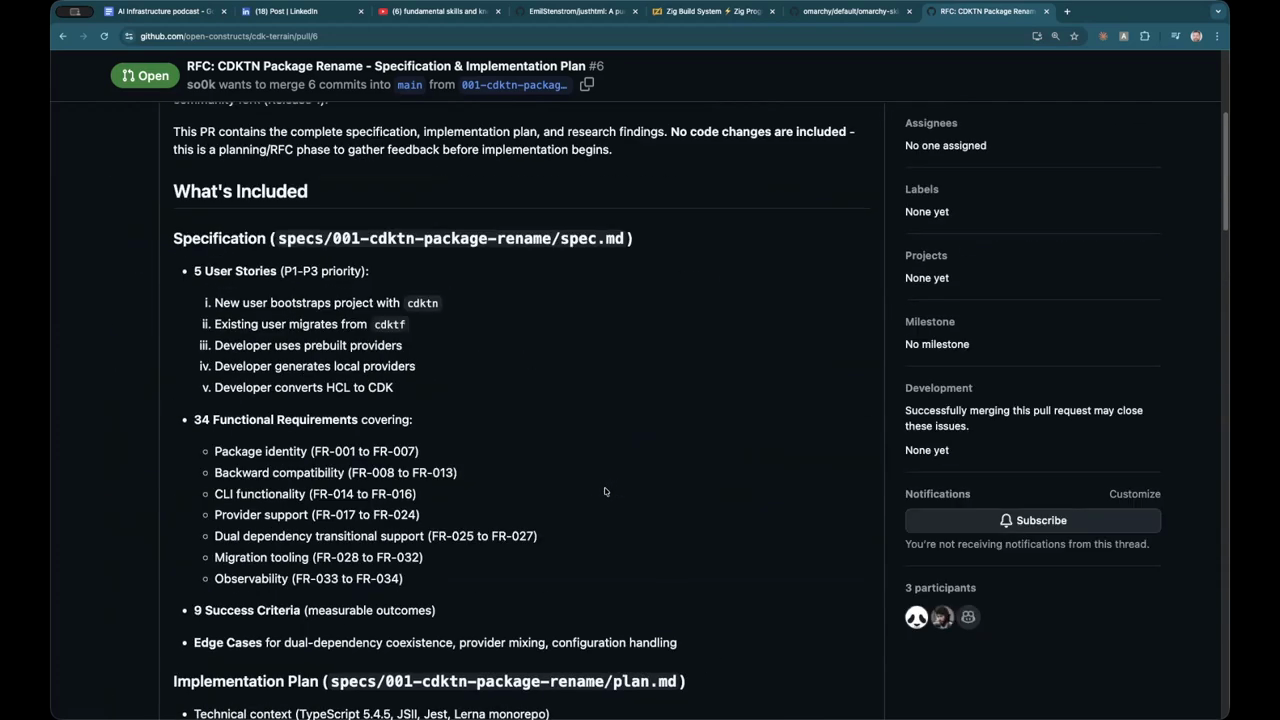
The hosts address the concern of “AI slop”—low-quality, high-volume code generated without proper oversight. They reference insights from Google engineers regarding the erosion of open-source quality when contributors use AI without a rigorous review process. However, the conclusion is not to avoid AI, but to implement better frameworks for its use. Tools like Speckit and specific GitHub hooks can provide the necessary structure for AI-assisted contributions, ensuring they align with existing code quality and validation standards. They highlight a case where a Google team spent two years building a network routing system, only for it to be rebuilt in a week using modern AI tools. This underscores the reality that while the “headline” delivery time is short, the underlying human effort in thinking, testing, and planning remains the most valuable component of the process.
Strategic thinking and career growth
As AI makes the act of writing code trivial, the value of an engineer shifts toward strategic thinking and the ability to say “no.” Kai reflects on the trap of “delivery mode,” where an engineer focuses solely on increasing velocity and clearing backlogs. True career advancement, especially into staff engineer roles, requires prioritizing outcomes over output. They discuss using ChatGPT’s advanced voice mode for mock interviews to practice these high-level skills, such as handling conflicts between short-term priorities and long-term goals. The future depends on their ability to improve around delegation and orchestration, planning and strategic thinking. The hosts emphasize that being a “good manager” of AI agents involves pausing to plan, being critical of the AI’s path, and ensuring that the final product meets a logical, human-centric goal rather than just being a collection of generated features.

Infrastructure as Code challenges
The technical deep dive compares AWS Cloud Development Kit (CDK) and Terraform. Kai shares a recent “nightmare” experience involving a two-year gap in AWS CDK library updates, which led to numerous breaking changes and circular dependency issues. While AWS CDK offers a high-level developer experience, it is tied to CloudFormation, which can be opaque when debugging deployment failures. In contrast, Terraform provides more flexibility in state management and runner configuration, often detecting dependency cycles during the planning phase rather than mid-deployment. The discussion highlights the “accidental complexity” of modern infrastructure, where multiple layers of abstraction—from service APIs to Terraform providers to L2 constructs—can create a “world of pain” for platform engineers who must maintain these systems over time.

The friction of platform engineering
The final segment explores the thankless nature of platform engineering and the difficulties of dependency management across different language ecosystems. While TypeScript and Go have relatively mature packaging stories, the Python ecosystem remains fragmented with multiple ways to handle project requirements. The hosts discuss the cultural divide between data engineers, who often resist updates to working systems, and platform engineers, who must enforce security and library upgrades. They also examine the cost and speed of CI/CD, noting that GitHub’s default runners are often too slow for massive builds like Terraform providers. This has led to a market for specialized runners like Depot.dev and Blacksmith.sh, which offer higher performance at a lower cost. The conversation ends with a look at the future of the “DevOps” role, which is increasingly focused on surgical updates and maintaining the feedback loops that keep AI-generated code from becoming a liability.
Model: google/gemini-3-flash-preview