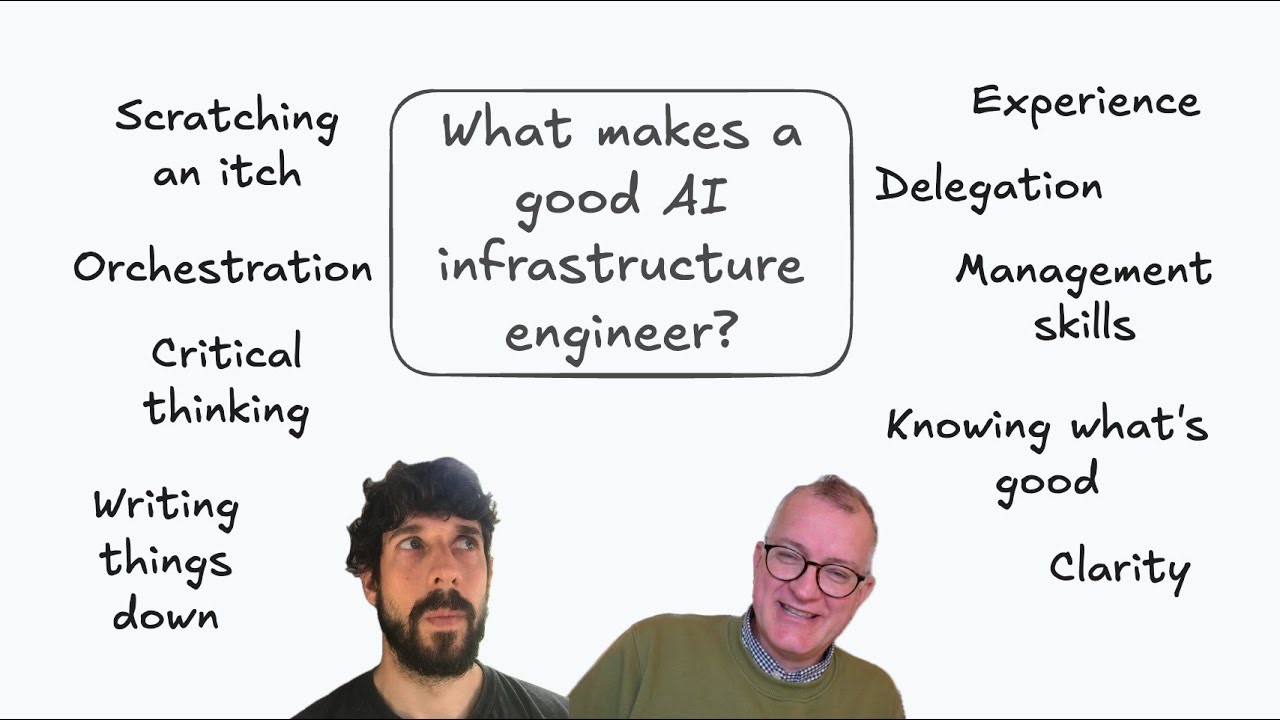
Episode 18: What makes a good AI infrastructure engineer?
Download MP3 | Watch on YouTube
https://docs.google.com/document/d/1zoc-0L1o1Cyxtgatb9fN_ZGBGbshZIb9BTzwEj0C4Gc/edit?usp=sharing
summarize "https://youtu.be/ij20sZmxC7k" --timestamps --slides
Kai Hendry and Vincent discuss the evolving landscape of AI infrastructure engineering, focusing on how large language models (LLMs) are shifting the definition of seniority from manual coding to orchestration and strategic thinking. They explore recent industry milestones, such as the rapid development of complex software using agent swarms, and contrast the developer experiences of various infrastructure-as-code tools. The conversation highlights the friction between rapid AI-assisted delivery and the long-term maintenance of platform dependencies, offering a perspective on how engineers must adapt to remain effective as “managers” of AI agents.

Agentic workflows and task delegation
The discussion begins with a critique of current AI agent frameworks like Ralph, which aim to move beyond simple sequential task completion. Unlike traditional planning tools where a human defines a set of steps for an AI to follow, agentic frameworks focus on delegating the generation of the tasks themselves. This allows agents to fetch work, insert new tasks dynamically, and operate in parallel loops. The hosts note that while this approach is powerful, it requires a shift in how engineers interact with tools, moving away from micro-managing code toward managing the “loop” of work. They also touch on the recent trend of “reaction” content in the developer community, specifically regarding how major AI labs are beginning to restrict third-party access to their subscription plans, forcing a more direct relationship between developers and model providers.

Rapid development and browser engines
A major theme is the unprecedented speed of development enabled by AI agent swarms. The team behind the Cursor editor recently built a browser engine in Rust, totaling approximately 3 million lines of code, in just one and a half weeks. While this is significantly smaller than the 31 million lines in Firefox, the fact that it functions as a rendering engine demonstrates the disruptive potential of AI. Similarly, an AI-generated HTML parser was created by feeding the HTML specification into a model, resulting in 3,000 lines of code that passed all standard test suites. This capability suggests that traditional software-as-a-service (SaaS) models, like Jira, may face disruption as it becomes trivial for small teams or individuals to generate custom, complex applications from scratch. Seniority is determined not by how much you code but by how well you can orchestrate and delegate.
Maintaining quality in the AI era
The hosts address the concern of “AI slop”—low-quality, high-volume code generated without proper oversight. They reference insights from Google engineers regarding the erosion of open-source quality when contributors use AI without a rigorous review process. However, the conclusion is not to avoid AI, but to implement better frameworks for its use. Tools like Speckit and specific GitHub hooks can provide the necessary structure for AI-assisted contributions, ensuring they align with existing code quality and validation standards. They highlight a case where a Google team spent two years building a network routing system, only for it to be rebuilt in a week using modern AI tools. This underscores the reality that while the “headline” delivery time is short, the underlying human effort in thinking, testing, and planning remains the most valuable component of the process.
Strategic thinking and career growth
As AI makes the act of writing code trivial, the value of an engineer shifts toward strategic thinking and the ability to say “no.” Kai reflects on the trap of “delivery mode,” where an engineer focuses solely on increasing velocity and clearing backlogs. True career advancement, especially into staff engineer roles, requires prioritizing outcomes over output. They discuss using ChatGPT’s advanced voice mode for mock interviews to practice these high-level skills, such as handling conflicts between short-term priorities and long-term goals. The future depends on their ability to improve around delegation and orchestration, planning and strategic thinking. The hosts emphasize that being a “good manager” of AI agents involves pausing to plan, being critical of the AI’s path, and ensuring that the final product meets a logical, human-centric goal rather than just being a collection of generated features.

Infrastructure as Code challenges
The technical deep dive compares AWS Cloud Development Kit (CDK) and Terraform. Kai shares a recent “nightmare” experience involving a two-year gap in AWS CDK library updates, which led to numerous breaking changes and circular dependency issues. While AWS CDK offers a high-level developer experience, it is tied to CloudFormation, which can be opaque when debugging deployment failures. In contrast, Terraform provides more flexibility in state management and runner configuration, often detecting dependency cycles during the planning phase rather than mid-deployment. The discussion highlights the “accidental complexity” of modern infrastructure, where multiple layers of abstraction—from service APIs to Terraform providers to L2 constructs—can create a “world of pain” for platform engineers who must maintain these systems over time.
The friction of platform engineering
The final segment explores the thankless nature of platform engineering and the difficulties of dependency management across different language ecosystems. While TypeScript and Go have relatively mature packaging stories, the Python ecosystem remains fragmented with multiple ways to handle project requirements. The hosts discuss the cultural divide between data engineers, who often resist updates to working systems, and platform engineers, who must enforce security and library upgrades. They also examine the cost and speed of CI/CD, noting that GitHub’s default runners are often too slow for massive builds like Terraform providers. This has led to a market for specialized runners like Depot.dev and Blacksmith.sh, which offer higher performance at a lower cost. The conversation ends with a look at the future of the “DevOps” role, which is increasingly focused on surgical updates and maintaining the feedback loops that keep AI-generated code from becoming a liability.
Model: google/gemini-3-flash-preview
Transcript (auto-generated from YouTube captions)
Good morning. It's 7:22 here in the UK
and you're listening to the AI
infrastructure podcast.
Vincent should be joining me soon from
Vietnam and we chat about infrastructure
because we're both infrastructure
engineers and we both love AI. So, we
just talk about AI too and what's
happening.
To get hold of us, uh, my email is
henry.fe.
I'm on uh
x.com kaihendry.
The website for the podcast is
debase.com/mpodcast.
d a b- s.com/mpodcast.
Please like which comment
otherwise
please do enjoy the conversation.
>> How are you? Can you hear me
>> finally?
>> Yeah.
>> Sorry. How long have you been waiting?
>> Oh, just a couple minutes. Just waking
up slowly.
>> 22. Yeah, you're earlier than usual
right now. You were waiting 5 minutes.
>> Um,
>> do you have time to look at all the
things I added into the document?
>> Yeah,
>> I was just uh waking up study and wasn't
HD.
Okay, let's have a look at the document.
Whoa,
there we have some. Can I share it on
the screen?
>> Sure.
>> Uh,
I see Theo's beautiful face.
>> Yeah, I guess if we're going to keep
quoting him, we should give him some
credit, right?
>> The fact is I I was like this morning
when I woke up. Sorry.
>> We're like the number one Theo fans.
It's like we talk about it.
>> Yeah, we're we're now doing what is this
format where we just watch a video and
react to it.
>> Yeah, we should react to Theo videos.
>> I picked up a couple of things that I
thought are so true. Uh what he said
that I've I feel the same way. Um and
then Primogen had me laughing out loud
quite a few times related to the
entropic move of blocking third party
access. to their um you know
subscription plans which was also very
funny.
>> Yeah. Like on the on the news front I
guess
um
I guess I've been I've been watching
that Jeffrey Huntley. Oh no, I I can't
remember his name. The guy the guy that
invented Ralph which
>> is it the human layers the No, that's a
different dude. Okay.
>> No. Um, yeah. If I look at my Oh, no.
I'm sure I want to show my my history.
It's probably quite dark.
It's very dark. Oh. Oh my god. Warren's
abs. Um, this guy.
>> Yeah. Jeffrey Huntley. He he he's he's
the the guy behind Ralph and he uh has
these kind of weird videos where he
talks about
Ralph and what you need to know about
agents, but he doesn't really ever get
to the point or into the details of
anything. It's kind of weird.
>> He's using Starship on his terminal.
>> Oh yeah, Starship. I've stopped using
Starship, actually. Uh
um but the thing that bothers me about
Ralph is that I I don't quite understand
how it doesn't really give you a
framework for generating the tasks. So,
>> right. Yeah, I know.
>> So, basically you're you're back at
specket looking back at specket or um
>> or I guess you could just use plan to do
it, but whatever.
>> When I when we talked about it, I wasn't
very clear because I mentioned it's just
a loop and you just ask the agent to
like find more work and continue. But
one of the biggest uh differences is in
in a traditional way that you use AI and
you know with the planning tool and the
to-do you create a couple of sequential
tasks and you complete them one by one.
But with Ralph, you delegate that uh
task generation. You don't tell it the
order or maybe you um the whole idea is
that you're able to insert tasks in the
middle. Like it's another pre um
predefined sequence of steps. And that's
something that we didn't cover. Like I
saw a video at that time that that went
into detail about like what why Ralph
Wigum is so good. Um because it um it
fetches work. But but we already do that
with with Beats, right? And Gasttown is
basically doing like Ralph but at the
parallel level.
>> Yeah. It's funny how like I mean inside
my consultancy company which which I
won't name but I feel like you know they
talk about problems and I think like gez
just use beads just use beads and you
this problem would be solved.
>> Anyway,
>> persistent man.
>> So um yeah where do you want to start?
Do you want to start at the bottom here?
>> Well, maybe you need to go up a bit
because if so, the first thing uh AI
handles coding humans think. Um, one of
the things that also this week was very,
you know, interesting in the in the
internet reaction. Of course, cloud uh
what is it? co- code or co-work being
announced and and and basically the team
Boris again saying we built in a week
and a half using Claude Code mostly um
bring Claude Code workflows. Yeah, of
course we built it in a week and a half
um and and um it was all done by cloud
code. Um what was I going to say? I
forgot. Anyway, the point was um and
there's another announcement related
that by the way uh the the people behind
cursor built a browser in Rust. No, in
Rust. Yes, they built a browser with the
full rendering engine uh which is like 3
million lines of code in a week and a
half using an agent swarm and they go a
little bit into details in how many
agents they ran. And then people said,
"Yeah, you know, Firefox is like 31
million lines of code." Uh but then we
can have a browser engine like like can
you imagine like WebKit or uh equivalent
that that can run the website. They say
it works kind of works. We were
surprised it worked.
>> Yeah.
>> Oh, there was a an AI generated HTTP
HTML uh parser which basically took the
HTML spec and produced a parser and I
was very impressed by that.
>> Produced a regular expression you mean?
Um, no. It looked like, hold on, let me
pick it up.
>> It's a It's a very common like Stack
Overflow question. You can't parse HTML
with regular expression. Let me repeat
that. You do not parse
>> HTML. It's like a very famous Stack
Overflow. And he repeated like 10 times.
Stop parsing HTML. I mean, this is this
is old news. This is this is 2025 uh
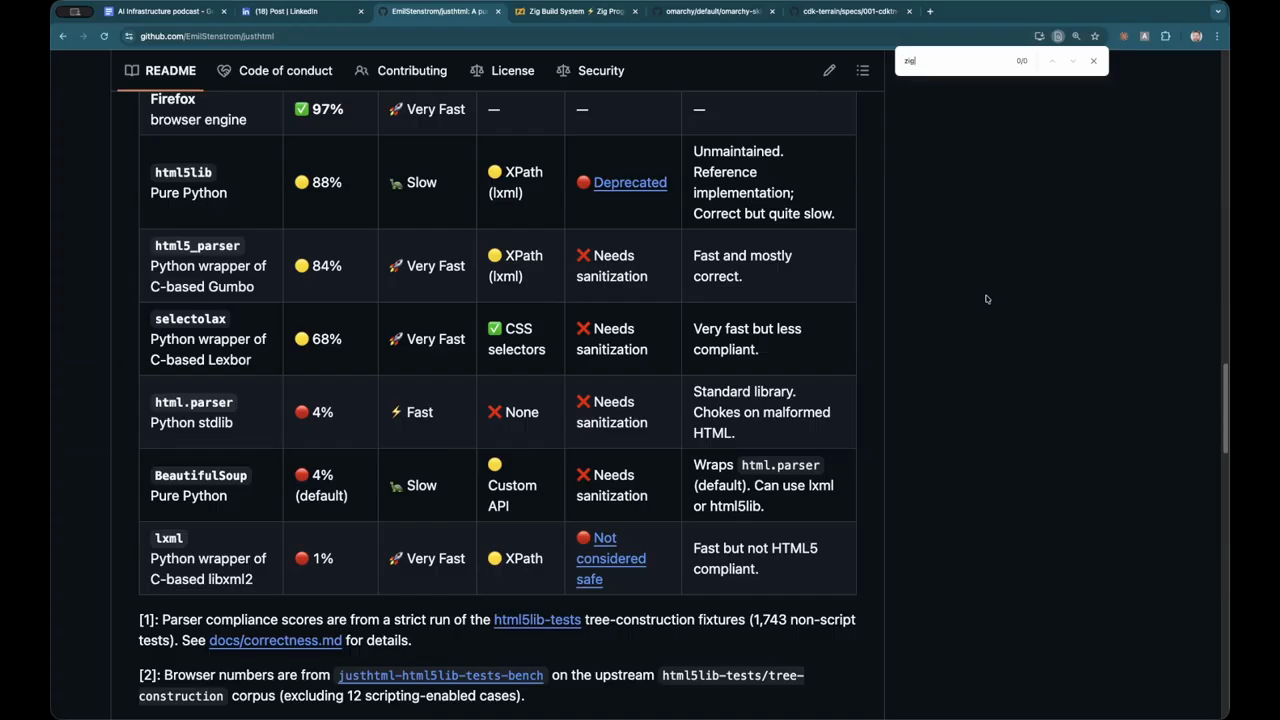
December. Okay. But there's this project
called just HTML
which completely generated by AI
and it's basically yeah the cool thing
about yeah HTML 5 lib like Henry Civan
and and friends has a whole bunch of
tests so it passes all the tests so it's
it's a brilliant thing because it has
the test framework obviously used it and
uh
>> it manages to to implement a whole
passing library in like Um, I think the
lines of code is Yeah. 3,000 lines of
code.
>> Yeah. Well, this one from the cursor
guys is three millions lines of code.
Um, I think we're going to see this more
and more now.
>> People coming forward with like we built
this thing in a week and a half. It's
millions lines of code. It was a swarm
of agents built it
>> and
>> it depends how well known it is, what
the testing suite is, I suppose. And
>> yeah,
>> but like for but like it's brilliant.
First comment you're going to get is
like they're not re they're not
inventing nothing new. It's no
innovation. It's just repeating what we
have. Like that's the common
>> trope I guess.
>> Yeah.
>> But I I often when I mean I in the start
of my career I actually worked on a web
browser engine called webvm which and
its innovation was to bring in device
API so you could use you know GPS and
accelerometer and things like this. So,
I was working with
browser engines. I was working with um
the W3C. I was in the mobile, I don't
know, task team or something. And I
always I always was a bit depressed
thinking that like uh like WebKit is
probably the only browser engine in
town, but and and and the web is
probably doomed because of that fact.
But now with AI, we're not we're we're
Like I guess we're this the lock in
level has gone down right because like
>> like I think we talked about it before
but like you know Jira like like oh you
can't implement another Jira
>> there won't be any more SAS everyone can
build their own SAS in in
>> Exactly. It's amazing, isn't it? It's
absolutely amazing. I feel I feel
>> it's a disruption.
>> I feel liberated if anything, but u
but what you just said about
>> I think I've just
independent. Yeah,
>> but more specifically the rendering of
HTML and Javas and execution of
JavaScript and the DOM and all that,
right? They are building um I knew like
for a while ago a zigg
u based
engine web like a browser but focused on
LLM so to represent everything as text
for LLMs to browse. I I I came across it
a while ago and I thought
>> but those sort of robots must exist.
They already been mean how else they're
pulling stuff off the web.
>> Yeah. But that was like a public open
source effort from and apparently
someone because I was interested in zig
and then I came across like different
frameworks in zig such as web servers
and then I came across um somebody's
course that
>> coincidentally I used to work with that
person.
>> Everyone wants to sell a course.
>> No no no no this is this person I worked
with them and they they are very open
source minded and they built a course to
really you know it's fully open source.
is not sold or anything like that but
he's also working uh as I was going
through this course and then the profile
I realized he was working on this
browser and I thought that's really cool
uh so he's very much working on on Zik
and that's really cool but but back so
those browsers for LMS but now all not
only SAS but also complete foundational
tools being rewritten and also brings us
to the point of like Linux
>> but that's mostly happening in Rust
right I don't know why Zig is on the
radar for you over Rust
Uh, bun is written in zigg. Bun is
acquired by entropic.
>> So,
>> bun is the super fast. Zigg is like a
modern C like it even it has a a C
compiler that is much faster. So, you
can even compile um cross you can use a
zig build system to cross-co compile um
C libraries and into different towards
to target different machine
architectures. So zig is even the zig
builder is even used as a way to port um
>> yeah go like go has that I'm pretty sure
rust has that
>> uh no go see go does not uh it still
relies you cannot like look at sql light
you cannot build or use sqlite with the
seago um limitation this is actually
like c cross compilation so zig is
amazing there but anyway the point was
that teams coming forward building whole
things whole libraries other teams,
other people because everyone says, "Oh,
you know, LLMs, they don't produce good
code." But then Linux going forward
saying, "I built this um audio
visualizer, uh a toy project." And um
and this also is like brought up in Te's
video where more and more people are
coming and saying like, "I don't write
the code anymore." Um and and Taylor
then goes on in in in his video about
like why is it that senior engineers are
more like more used to or more
acceptable to um to AI tools to LLM
tools and then I saw some interesting
comments like yeah they're used to see
and review other people's code like
junior code so they know what code might
look like and the second thing that they
highlighted and if you put the document
on the screen you will
is that um seniority is determined not
by how much you code but by how well you
can orchestrate and delegate and those
are management type of uh you know
capabilities. So as you are preparing
yourself for a future of AI agents, you
need to move towards what they regularly
attribute to staff engineers which are
better at uh setting like delegation and
orchestration of workflows which is the
real differentiator between juniors or
seniors and staff.
>> Yeah. So I guess I I would agree with
that that uh
>> observation.
I mean at at work I just flippantly call
it just writing things down. Like that's
the difference between a junior and a
senior. you write things down and uh
yeah but that's a bit flippant but uh
what what what is really needed is is
absolutely you know quality
concise
uh documentation to get things done
>> and a clear goal clear structure just
clear thinking clear thinking is
actually um I guess the number one
skill to have right Because if you don't
write clearly,
you're not going to get very far with AI
as I feel. I mean,
>> I disagree.
I don't think I write very clearly. And
>> okay, maybe maybe write clearly is not
quite what I wanted to say. If you just
if you just can't express yourself or
something or express your ideas, it's
going to be a struggle.
>> A different angle as well. Um, so I've
been doing speckit for what since around
November or October and then with beats
around November and what this has taught
me I was not good at writing clear
specification documents and things like
that. Specit gave me a very good um
experience of like that's exactly what I
need right now. I mean I hadn't really
had the experience of working in
environments where this was you know the
the common practice. So, I wasn't good
at writing those documents, but when I
saw them,
>> that's a good point.
>> Yeah. When I saw them, I knew that
that's that's really good and that's
what I like and and that's that was
embedded within the prompts that
>> So,
so it sounds like the senior people like
you and I, senior seniors,
the the trick up a sleeve is that we
know what it what's good,
>> not necessarily that we can produce
what's good. In the meantime, this is
what happens to my art my hyperland.
>> Yeah, you've shown that to me before. It
doesn't happen to me actually. Got to
you got to get yourself the dual monitor
or the GPU drivers that I need to
update. I don't know. Yeah, that's Yeah,
that's that's interesting because yeah,
I I take back what I said because
>> because
stuff that I've written and then when
I've launched gone into plan mode and
then and then I've asked for for clar
asked u claude for for clarity and uh
with ask question user tool. It's
actually been an amazing experience.
>> Exactly. Well, I agree with you that I
think the difference between senior and
junior is that a senior, like you said,
is going to write things down, maybe be
flippant, but it's going to pause and
plan ahead, which is like when you start
with Claude Code, you you go into plan
mode and you already get like a very
fast feedback loop and you're like very
eager to jump into the code and to get
it done.
>> Uh, but once you go into more of spec
driven environment,
>> then you really have to spend like I
told you at the start 80% and this is
also being repeated by many people
>> some some water falling. No, I'm joking.
>> Some some Yeah, you're right. Yeah, it
is.
>> You do a lot more upfront thinking about
like, you know, ultimately these these
large language models are great at
hallucinating, right? At at at thinking
outside of the box. They have this
amount this massive, you know, I would
say library of words to choose from. And
they very easily pick between which
words, right? When you say something, I
don't like that word. Oh, how about
these other 10 words? Which one do you
like? They're all similar. And I was
like, "Oh, yeah, that one is good." So,
so they're very good at like um you
know, with words. Obviously, they're
large language models, right? So, so
they're very good at that. And they are
very good at looking at a specification
and then coming up with like what if
what if this, what if that, what do you
do if the user doesn't have uh what if
the user doesn't have the credentials
ready? What if the the process fails
midway, you know? So, so it comes up in
all of these cases. you know, you you
set out your original, you know, goals
that you want to try and get and then it
it builds like,
you know, the more context it built
around the topic, the more it can, you
know, think about alternatives and it
helps you, you know, come up with these
things very quickly.
>> So,
>> and I'll give you
>> Yeah, sorry.
>> Yeah. I mean,
I'm I'm just looking at the slide there
that you screenshotted with the
orchestration delegation clarity. I get
I get orchestration. I think that's what
we've been talking about like
>> what he he means with delegation is
breaking like complex problems down into
small steps and then handing these off.
>> AI does that for you.
>> Uh maybe yeah but you need to know what
if those are reasonable steps. You need
to understand that this is the the path
that I want to go. You need to be you
you may also you need to still be
critical and think like wait a minute
like I've had several instances with
LLMs that they go a certain way and I'm
like hold on a minute we're like we're
going in a circle here like or we're
going in a massive detour. Can't we just
>> maybe I'm just I'm just being panted by
delegation. I guess delegation to me
Okay, let's move on.
>> There's a lot he he he gives a lot of
context around this this this um
diagram, right? and and I I listened to
it and then we should put the link in in
our video because it's a it's a really
good one. Um
>> but what I shared above that is kind of
like I I I read four or five things
before I started work. Uh the first one
was uh with AI writing code is fast but
yeah this is common that we we talked
about that right uh the Google team uh
spending two years building a new I
don't know network routing or load
balancer system and then ultimately
rebuilding it in a week well duh I mean
it takes it takes weeks to
>> actually I like your point in in the
previous podcast that like you never see
that cost you know captured like the
fact that people have been thinking
about this for weeks if if months at
advance, but you you only you only see
the headline that it took a day to
build. You don't see the fact that you
know all this human effort went into
thinking and testing and coming up with
the idea in the first or the the details
of the the plan in the first place or
something or or all or all or all or all
or all or all or all or all or all or
all or all or the lessons learned
rather. What what I I took away from
long time ago was if you want to be a
successful like at startup or founder or
creating something you must be very
critical of the world you must you must
also see like
>> I don't like this there must be a better
way and then come up with it like if you
have an inconvenience or or something
that bothers you and that's our role
right once we have these we discover
these inconveniences and we think how
could we solve this differently that's
kind of like
>> I'm just going to write some I'm just
going to write some of these things down
Oops. If I could just spell.
>> I'll just carry on. Ignore me.
>> Dictated. Dictated.
>> I was just trying to
capture the things that I think are kind
of working in my favor at least.
>> Right. The next thing um was Greg
Mccluki's post. He's one of the creators
of of uh you know within Google on on
Kubernetes. And the post started with
the very you know that when I started
reading it I was like oh this is like
complaining about Tailwind losing its
business and you know uh basically the
erosion of of open source um no funnels
no way like no new foundational
libraries being built the whole thing is
collapsing right because it was like
open source as a problem but his focus
was more like we create like things to
work on in our project and then people
generate a massive amount of code and
they don't really care about the review
process like is this good code or not
and and he and and then I said like oh
this is complain about AI quality but
then he actually gave a very good
conclusion so the at that time I think
most people stopped reading because all
the comments were like oh AI slop AI
slop this AI slop that but the the real
crucial point or takeaway from his post
was at the bottom which is like we as
engineers have to as leaders have to put
in is you know teaching how we other
people can use the tools the AI tools
he's not saying don't use AI tools he's
saying we need to put in place the the
the framework for people to use the
tools correctly so that what they
contribute and generate with with those
tools is not slop but it is you know in
alignment with our code qualities our
verification our validation you know so
if you are uh an open source repository
uh maintainer put in place all of the
tools like put in place uh speckit
some hooks.
>> Exactly. Put in put in all of these
things that if somebody clones a repo
and starts working on it and they open
cloud, uh it immediately says, "Hey, I
see this is um there's a couple of
skills here that I can use to work and
contribute on this."
>> So, so
>> I thought that was a very good takeaway
and half the comments in reply did not
totally miss that because that's you
only notice and know exactly what he's
talking about if you actually done these
things.
>> Yeah. I mean, I'm so impressed with the
DHH and Amachi because because I launch
Claude inside inside Amachi and
immediately it picks up the skill.
>> So immediately you have the AI aware
environment for what you're trying to do
on your on your Linux distribution. Um I
mean it should be lorded as a as a
pioneer in this respect, right? Because
like I don't
>> and I'm doing the same thing.
>> Okay, fine. Um maybe he's a pioneer
because he has already done it. But I
hadn't seen the the Omari skills, but I
was just saying the same thing. Um since
we made the public announcement of um
reviving the project that was sunset by
IBM um it's an open source project. I
just integrated specket into it and I
set up with a cloud skills for beats and
I generated the first spec which is how
do we rename it like what
>> what's what what what is the user story
for for
>> is it the CD what con
>> it's called CDK terrain now like CDK
terraform uh terrain
>> let's see if uh
>> yeah that one well there is good so if
you look at the the latest pull request
u the lot the the one that I just
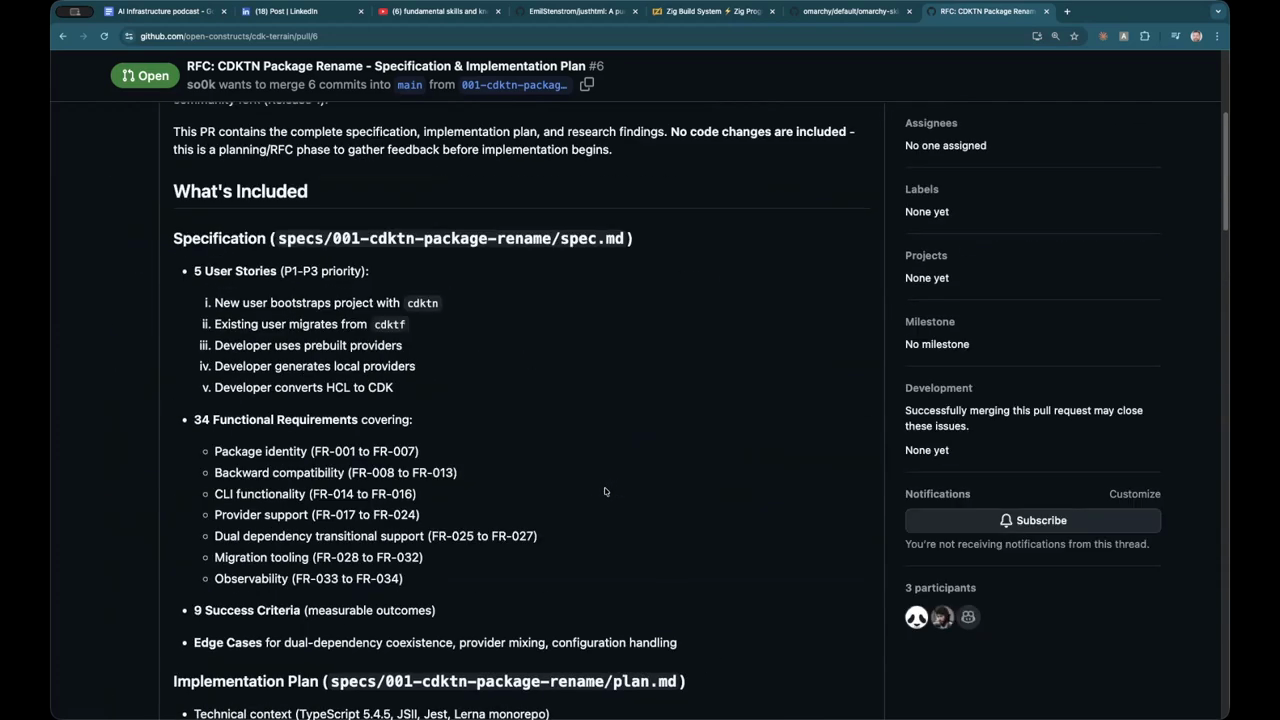
Um there is the RFC the rename.
Yeah. So so this one
this is all Claude Code generated like
the purpose the user stories the
function requirements
>> the spec inside the github issue.
>> No no no no the spec is on the branch.
This is just a summary of everything
that I committed in this particular
thing. I ran
>> I ran three commands uh which is I ran
the the specify to generate the the user
stories spec ledger is my fork which is
all my customization of specit cuz the
guy who manages specit left Microsoft
he's now atropic he joined the labs team
I believe
>> oh my lord oh my lord
>> yeah he was he was working on mcps like
under a lot of conferences at the end of
the year he wasn't doing anything on
specket anymore except for maybe merging
some like PRs. But so this is what I
expect like in terms of quality. And the
funny thing is I didn't really tell
anyone but I shared it with some people
and I wanted I was waiting and like oh
is this AI slop actually maybe because
they didn't know they were like you are
really good at writing user stories and
I'm like I didn't write any of those
actually. I mean I spend a lot of time
fine-tuning them and reviewing them and
making sure they're aligned with what
I'm trying to do.
>> Where are the user stories here? Sorry.
>> Under spec. So just above the cloud MD
on the left side. Yes.
>> Yeah. Again go to the branch and look at
them. It's more logical. I mean
>> yeah well that's faster. So user story
one like new new user bootstrap after
it's been renamed and then you have
acceptance scenario. Given a developer
has installed the CLI when they run the
init everything will work. You don't
have any dependency on the old. This is
interesting cuz this is one thing I have
a bone about your typical user stories
is the acceptance scenario
um
doesn't
address the fact that some of these
things you know it's like
okay this is probably just me moaning
but like a lot of cards that I pick up
it's like okay uh if this new update is
being done then uh you can now deploy
the new version of Airflow or something
like this, but there's no like like real
test other than manually
verifying that something has been done.
Um, and I'm wondering and just aloud
here,
you know, since I see this or something
like this, can like are your tests um do
your user story acceptance tests
actually become tests is what I'm trying
to say.
>> That's that's what the whole idea of of
Kiro and AWS is, right? it's to turn
they put a lot of formal parsing and
they are forcing the LLMs within ko to
write the acceptance criteria in a
format that they can formally parse and
generate BDD uh behavioral
driven development right it it it
doesn't come back to you and say like oh
task done but uh you know I couldn't
write I couldn't write a test for that
one or something like that or you know
because that's what happens in in real
life is like a a developer comes back to
me and says like, "Yeah, I've done
this." Um, all I I have a screenshot to
prove that it's done and I'm like,
"Okay." Um,
>> how do I prevent regressions? No, I mean
like obviously I'm not working with
people anymore, so I don't trust
anything the LLM says. It has to have a
test. Uh, the thing is it's going to
write tests for everything, which is not
always good. Uh, but it does it does
write.
>> No trust for the AI.
>> No, but that's one of the main things
that everyone is saying now, right? I
mean our role is to to orchestrate and
defineation.
>> I just I just think it's interesting in
a way just to sound out these
differences
>> at least for now. But if we go back to
to like the narrative of Theo, which is
ultimately what I also feel because I
never wrote user stories this good
before and I got the comment now this is
really good. You write really well. But
I'm like I did write this anyway. Um but
>> yeah going back to the
>> Yeah.
point which is which he made at the end
of it. Um because writing code is now
trivial, right? We can we can get
someone something to do it for us. Um
but if you scroll down even people like
Linuvaults who wrote the kernel and um
you know that they also say those people
don't even write code anymore, right?
Most of the time they have an an idea
and then they put it on the mailing list
and someone picks it up and works on it
and then they like it, they review it
and they can merge it. But he said also,
and this is exactly what I'm trying to
say, is you can become a good manager
this way because you pause, you create
your plans, you you you review, you do
that over and over and over again with
AI agents. They're sometime going to
deliver what you want and they're
sometimes going to fail miserably. And
you're going to learn that I had this
stupid word in there and it tripped up
the AI and it started doing all this
additional stuff that I didn't want
because of one or two words. stupid
things like error messages must be clear
or that's obviously something you want.
>> I mean, we're talking about a good
manager of of AI agents here because
like
>> that's the future to be honest,
>> but I'm I'm a little bit confused
because, you know, I'm a I'm a I'm a
middle manager as I mentioned before.
There's a few people that I work with.
Um I'm a lead in a team.
What does it mean for humans?
So, so what Theo was saying here, you
can become a good manager and the future
with AI adoption. The people that are
thriving are the ones that, you know,
have learned that their time isn't best
spent writing code. And I'm quoting Theo
exactly because I wrote it down. Um,
they're they they know that their time
isn't best spent writing code, but
better spent thinking about
>> Yeah. I mean, I'm just thinking aloud. I
mean, I guess I got to get my colleagues
to be managers, I suppose.
Yeah. Um
>> they all need to come up to
Yeah. learn these skills.
>> What's the other thing he said? Like the
future depends on their ability to
improve around delegation and
orchestration, planning and strategic
thinking, which is what I'm I have an an
interview tomorrow for like a staff
engineer position. And um
these questions trip me up, you know,
because every time I it's very I I use
CH GBT. I said I have here's a JD the
job description. Uh I gave my background
of what I've done in the last five
years. So it of of course it starts
glazing you saying yeah yeah yeah
perfect you can do all of this. Yeah I
don't care trust it. Um and I said look
we're going to do practice interview
right and it ask me these question and
you go into voice mode and it goes into
this very very it's it switches in
another mode. I'm sure I'm not making
this up. It go it switches in a special
interview mode that they built in
ChachiBT and it asks the question and
then it waits for your answer until you
stop talking and then it gives you the
feedback. You went too deep on this.
>> Yeah, it's amazing.
>> You're using you're using JT advanced
voice mode or something.
>> Yeah, I I used and play with it before,
but I I I thought you know
>> I find it stutters back at me more than
often.
>> Your internet connection is pretty bad I
think.
>> Oh no, no it isn't actually. Actually,
this this goes
>> you're probably on like a more than
>> on the topic of strategic thinking. I
for some reason I randomly watched this
video yesterday and it it didn't have
many views and it looked like clickbait,
but since I was doom scrolling, I I
watched it anyway because it it was
different to all the [ __ ] I was
watching last night.
on on the topic of strategic thinking. I
think it's quite interesting because as
a as a consultant when when I when I
join a client, you know, they have a
bunch of problems
and usually since I'm in delivery and uh
and usually since a client often doesn't
really have a good vision yet. I mean,
we we work on this problem, of course,
but but often I'm thrown into the the
deep end and uh we're just trying to
sort out the delivery and then often
there's lots of tasks in the backlog and
I just I end up basically saying yes to
a lot of these tasks. I will do them.
I'll do them. I'll do them. And
especially now that I have AI on my
back, I can do these things very very
quickly. I can just pick up cards. And I
guess in my in my in my my caveman mind,
I'm thinking like, you know, my velocity
is going to look insane. I'm going to
look great because I'm so much more
productive than um the other people on
this project. But it that's kind of
stupid thinking after watching the video
because because ultimately, you know, he
was pointing out that no one no one gets
like promoted or um by doing lots of
work. You know what I mean? Like that's
not how it works. You need strategic
thinking. It's about saying it's by by
showing that you've prioritized some
things over another for a particular
strategic reason. Uh it's it's about
saying no. It's about it's about
reaching a certain outcome. I mean, I do
try to reach an outcome when I'm in a
client project, but sometimes the the
outcome or the customer is just opaque
to me or um and I'm just doing the best
on the delivery front. I mean, that's
that's where I am in my career to be
honest. I'm in I'm in I'm in stone cold
delivery, but now but now stone cold
delivery is is somewhat solved by AI. I
want to move up in the food chain
and I'm actually just asking myself how
do I get there?
>> Yeah. So, Chachi gave those questions as
well in during my interview
specifically. How do you deal with
short-term priorities against long-term
goals? Um how do you deal with conflicts
like in terms of when you are um not
completely agreeing with the direction
something's going? So you know these
type of questions where I responded with
like examples of previous scenarios I
had been in and then it told me look the
things you did there and the way that
you work is clear communication setting
responsibility boundaries setting this
and that. So
>> uh so it's really focused on these um on
these um it's a good mock interview just
telling you and and also maybe it helps
you also clear form a better view. I
then practice with my family and every
time my son or my wife said something I
said look I hear you but how about we
are going
>> until they got like nause annoyed by it
>> you want to you want to drive to a
certain outcome and uh almost I mean
maybe I'm going to getting too adult by
the video that watch like you're almost
going into politics now or something
like that because
>> you're dealing politics
But the the the the advice I got from my
dad who's been project like working for
for his whole life project manager or
director and then he told me the most
important is when you go for such
interview is because I was like I'm not
prepared. I have all these things that I
I I I stumble on these questions like
all you have to do is pause and sound
like a reasonable human being. Make sure
you're well rested. Make sure you sound
like you uh you have logical thinking.
Nice.
>> Yeah.
>> And and and and and calm down just
>> Yeah. The the let me tell you just a
quick story like I was at I was in um a
private Catholic school in South Africa
and um there was lots of exams and I and
sometimes I would just struggle and then
the uh the sort of uh the headmaster uh
Mr. a he said to me, "Kai, did you get a
good night's sleep?" And I said,
"Actually, no." I was kind of like
thinking about this and working through
this. He says, "Go to bed early,
>> get a good rest." And then I I followed
his advice and I was like amazed how
much I mean I don't know if if the
results were immediate but I can't
really remember but I was amazed how
much how how less stress and how better
the exam went for me and I think the
results also reflected that and it was
just it was just such a simple thing.
That's true. I mean, I have the same
like every time I'm stuck uh working
late trying to get something over uh you
know, done and you don't know when to
stop. You just want to keep going and
ultimately you're too tired. You just go
to sleep and then you spend an hour and
when you wake up you wake up and you
think I could have done that in 5
minutes because honestly I was just
wrong at this point and I could have
just figured it out way faster
>> if I had a clear vision. If I had walked
away a little bit and and thought about
it. So
>> yeah, I'm just I'm just worried that
I've been doing things wrong for for so
long now because I guess I've just been
in this crazy delivery mode where I
just, you know, for me it's all been
about improving velocity, getting the CI
working, improving quality, build,
build, build build.
>> And AI is definitely making me reflect
on this all this stuff now.
>> Yeah. And I think that's
That's why, you know, I'm doing that
interview more as a practice round
because I'm not sure I'm going to get
it. Although that with all the good
advice, maybe I'm able to surface more
the qualities that I I do have the um
you know, I have dealt with those
situations. But like like you said, I
also went like heads down harder work to
get it done. Um which doesn't help in in
in like a collaborative environment
where we have to like communicate and
and find out and know how we can meet
the targets and things like that. Right.
So, I don't expect to get it, but I do
feel like with AI, I've learned a lot
more about pausing, planning, and taking
on more of a higher um, you know, level
or strategic thinking position. And I'm
trying to apply that in in this in this
open source thing that I'm doing based
on blue.
>> I mean, like your your CDF CDK terrain
or what was it called before? Uh,
>> CDKF. Yeah, CDK.
>> CDKF. Yeah. I mean, you're you're
becoming a credit a product owner and uh
I mean, do you have
I mean, hopefully you have some users
that you're getting some feedback from.
And
>> yeah,
>> if that's happening, then you're you're
on a good path already. You're in a
better place than I am. I mean, I
>> don't know if you remember, I did used
to have my own product uh webcon
converger.com
and own business to go with it. I mean I
was I was earning money
>> with it
>> and uh and that was my life for a few
years and it was good times in a way but
the
but I guess since it was like one man
band
>> you could revive it now you have a
fleet.
Yeah, I I don't think the, you know,
these kiosks that you see in libraries
and things like that, I don't I mean,
maybe digital signage is still a thing.
>> Um, but but the I'm not too sure the
market is there for for that product. Um
>> Mhm.
>> I mean, but yeah, you're right. I could
revive it. I I should I should I need to
become a product owner really. Uh just
like what you're trying to do. I mean or
what you are doing.
You got Souk and you got Vincent. You
got
>> It's my You got a few You got a few
personalities that I'm online.
>> I didn't realize I was logged in under a
different account and I was like, "Oh,
whatever. I don't care." I could have
deleted and do it again.
>> Yeah. So, I wish you like I mean, we
should we should turn this podcast and
like how to have a successful business
a successful product owner. Um
I I guess so this is still does this
have a business are you going to are you
going to get people to pay for it
>> somehow?
>> No, absolutely not. This is open source.
>> Oh god.
>> How are you going to pay for the
>> there are companies depending on this
>> Vietnamese soups?
>> I don't I don't know that's not on the
prim that's okay. The first and foremost
I do this because I want this tool. I
don't want it to die. I've I built terra
constructs because I'm tired of
terapform modules and I don't want to
write another line of terapform module
code in my life ever again. So well
that's too much. Of course if I'm look
looking for an opportunity and they are
on terapform modules I'm not going to
force them to use my library. Um I'm
just going to keep telling them every
time I'm upset.
>> Can I just relate? I had a I've been
debugging furiously the last two days a
CDK issue at the client. it was the
circular dependency uh problem
>> and I don't feel I would have hit that
with Terraform. I don't know do you have
any opinions about circular
dependencies?
There's so many companies when I come
into organizations that have rolled out
Terraform without having any prior
experience into it and a common scenario
is they they try to centralize um like
the classic thing about security for
example this module does all of the IM
roles this module does all of the
security groups because this is like the
central IT type of setup whereas uh
you're you're going vertical this
product owns this security group this IM
role this belongs to that product it's
like vertical slice versus horizontal
But the trouble is that in this
particular client they've gone CDK
across the whole platform in like they
have a storage stack, a security stack,
a network stack.
>> Yeah. So the storage stack gets a bit
mad.
>> So of course you're going to have
vertical and and uh teams are going to
own shared resources. So you must uh but
usually the type of cycles you describe
happen in terapform similarly as in
cloud formation which is you are
creating a security group over here and
then you are um you know creating the
thing over there and then you need to
cross references and they end up
depending of each other and now you have
to deploy this first and then you have
to apply that and then you have to
>> I was just I guess I was just a bit
>> I was just a little bit I thought maybe
the the ergonomics of the CDK developer
experience was not
cuz I feel like with terraform when when
I see dependency issues it's very clear
because the way the way that this
problem
>> this is not a CDK like please use the
word AWS CDK when you talk about cloud
form okay because
>> because I do not use cloud form I use
CDK for terraform and now CDK terrain
where all everything you said about like
CDK doesn't give me the clarity it's AWS
CDK doesn't give you that
>> yeah yeah the AWS CDK tool yeah yeah
you're right and okay god this is going
to be difficult to talk about have to
prefix everything with AWS. So the way
that this problem manifested itself with
the AWS CDK uh diff it it showed like
all these IM changes
and then an AWS CDK deploy
basically
bailed out because of all these circular
uh dependencies.
>> Yeah, cloud formation can be very
painful. Uh Terraform is going to tell
you that very quickly. It's going to say
I cannot plan this because there's a
cycle detected early. If you do it
within Exactly. So, so I guess my my my
moan is about how diff and and and
deploy
>> were like
>> not really lining up very well. I mean,
>> yeah,
>> it confused a lot of people and then I
then as the most experienced person on
the project, I picked it up and I was
like banging my head for two days.
>> Yeah. So, so the thing is that's exactly
why I am doing what I'm doing which is I
love AWS CDK developer experience but I
do not like the things that you just
described which is problems with cloud
form not uh you know the same
flexibility in how I do my plan and diff
because uh with cl with terapform you
have atlantis automation that you can
use you have so many tooling around it
you because with AWS CDK you are tied to
the cloud for runners of AWS and however
they make it available. It has pros
because you don't have to deploy your
runners. You don't have to worry about
the state where you're going to store it
because cloud form is taking care of all
of it. It's all it's a full package
solution. It even does the full roll
back. You can do it across regions. It's
amazing. But I do not like it. Terraform
is is way more flexible. You control
where you put your state. You control
how you do your runners. Do you do it in
GitHub workflows? Do you do it with a
dedicated instance? Do you use
spacelift? You can choose everything you
want. So, so that's why I'm working on
CDK terrain and that's why I'm working
on my library.
>> On the topic of CDK, another thing that
sort of blew my mind was that the the
client uh hadn't updated AW CDK uh
library for uh for for like two years.
No joke.
and uh and that's something that I had
to pick up
>> and I picked it up and and when I looked
at the change log um you know over a
period of two years I was a little bit
uh how do you say
shocked at how many breaking changes
there were cuz because this is a a large
landscape I'm upgrading the CDK library
across and I'm like oh [ __ ] um you know
oh [ __ ] oh [ __ ] Oh [ __ ]
Almost every release there's a breaking
change.
>> Terapform provider AWS from version 4 to
5 to six have also breaking changes that
you want to upgrade the provider you
have to change the way that you write
your security group rules. Uh they need
to be individual resources.
>> I mean I don't remember this being the
experience in terraform. I mean I was I
was shocked. I was like, "No, no, no.
This is not happening to me."
>> Because the same the same happened.
>> This is I mean I
>> Is it the same in Terraform?
>> I just told you. Yeah. Terraform
provider AWS version 4 versus
>> Sorry, I thought you were talking about
um
>> No.
>> So this is the same this is the same
problem in terraform. Okay.
>> Yeah. If you have a very old version of
Terapform provider AWS version 4 and you
need to go to some feature that like
some for example SNS topic true is is a
thing that was missing a property that
was added on the SNS service and it's
only available in in provider version
v6. So you have to upgrade to version v6
and there's quite a few breaking changes
from 4 to 6. So you're going to and that
was even worse when you were in
Terraform 0 0.12 to uh 0 before it was
v1.
>> You're right. You're right. You're
right.
>> Yeah.
>> Okay. I guess I'm just looking at
Terraform
in with
it.
>> I think Terraform surfaces these issues.
Um again, the problem with AWS CDK that
I will agree with and that everyone
tells me when I talk about it, it's the
additional complexity. This is this
accidental complexity versus because now
I mean imagine this. AWS has a team
within AWS that builds a service SNS or
IM team or another one, right? They
build an API. These are all not
identical, right? We I think we talked
about this. You said that's weird
because Jeff Bezos
dictates that everything needs to go
through an API, but SC was every team is
building their own API around their
services. So some like for example if
you use API gateway and you want to set
uh a different integration method
parameter you need to JSON patch it into
like a you know you need to send a JSON
patch to modify the object there's no
individual like sub resources like what
you expect with REST things like that
right different services different APIs
now from those services people wrote a
Terraform provider manually right and
they're going to like abstract the
configuration away they're going to take
the way that Jason Right. And then
>> and for the most part they've done a
great job but like it's yeah it's hard.
>> Okay. And then you have these resources
right that are basically kind of an
abstraction on top of those APIs. And
now we are building another abstraction
on top of it which is like these L2
constructs which are basically wrapping
those APIs uh wrapping those resources
which are wrapping those APIs which is
like
>> how many layers in between are we here?
Like this is ridiculous right? Yeah, we
talked about this before, but like I I I
was naive or or something cuz I always
thought that that there was some sort of
common I thought it was called Mason or
something. Misison or
Amazon.
>> Yeah, we talked to we had
>> Yeah. and and that was and that was
splitting out things and you pointed to
that project which was I think more akin
to that but in reality people are using
Terraform provider and this uh CDK
library and we're basically
>> in this world of pain in a way because
it's man dude like this month debug
session with all these breaking changes
over a two-year library jump was
you know not fun.
>> Yeah.
>> Not fun. And and and to be honest, we
haven't deployed it into UAT yet. It's
only just in dev.
>> And and the trouble is like I feel or
maybe I'm taking things too personally,
but like I do the work. I own the I own
this sort of migration,
which is a result really of people not
keeping dependencies up to date. And
then any any feedback about things
breaking is going to come back to me.
Oh, Kai, it's it's your fault. Your
fault. Your fault. Your fault. Your
fault. Like
>> so DevOps is the thank most thankless
job, right? In like platform engineer.
>> Yeah. And then there's no tests for all
these like I have like I have zero
confidence that that the test suite
managed to capture any of these breaking
changes.
>> That's the problem. That's the problem
with how the industry has approach
approach the platform engineering. They
they still clinging to config files and
and and and saying that yeah we can't
test the system. Like just a few days
ago, somebody uh from Terra team posted
Malcolm posted um the thing people don't
understand is that you cannot test your
infrastructure the same way that you
test your programs. And I'm like yes you
can. And he's like no you can't because
when you do your network in production
and you set up your security rules or
your networking rules there's no way for
you to test that. Only in production you
can validate that it works the way it
should. And I'm like, but I agree with
that. But there are things that you can
test in the middle. Like you can test
patterns. You can build patterns.
>> Have you heard this project? Have you
heard of this project? I thought you
might have used it. Goss.
>> I've seen it, but I don't remember.
>> I think it's like um
wait, it's like YAML driven
infrastructure testing like
>> Oh,
>> test for certain things. And
>> I used
>> I used RSpec once which is like Ruby on
real uh Ruby based uh service
specification testing.
>> Yeah, man. I'm a bit depressed. I think
the next few days with this roll out and
everything breaking around me, I'm going
to get so much heat.
>> Yeah. So, so you you you touched on two
points because you said first um you're
doing all the work and you're only
getting contacted about breakage. nobody
appreciate the work that you're doing.
And second, we talked about there are no
test.
>> Well, I don't I'm not looking for
appreciation. I'm just looking for like
>> No, no, look, this is this is
>> understanding about this this I mean
like this 2-year AWS CDK upgrade is is
an absolute nightmare in a in a very in
a in a very I mean we're talking like
like
>> and what are you doing double digit AWS
accounts?
>> What are you doing to prevent this from
happening again?
bloody definitely going to update the uh
the py project toml every freaking
release.
>> No, but like what do you do to make sure
that that going forward every time a new
AWS CDK version is released, every
single um piece of infrastructure that
uses AWS CDK gets a bump?
>> Well, that's a good question. I mean we
we need a process where we we we do have
incremental changes.
>> Yeah. So there's two parts to the
problem here like there's I'm focusing
I'm a platform engineer so I'm doing the
I'm doing the platform up uh AW CDK
library upgrade
>> that that's that's two years in the
making
>> but this utility library is also shared
with all the uh the data products in
this platform.
>> So so basically the CDK is going to
update for two years. So all the all the
um the data products depending on this
library have now got a 2-year bump in
their CDK.
Uh thankfully most data products don't
use the CDK but some do.
And of course like like Kinesis Fire
Hose went from alpha to stable. I mean
every anything that has kinesis in it. I
I'm I'm I mean yeah I'm having to work
on my own platform but like sending PRs
to product teams saying like um oh by
the way uh you probably need to update
this code here and this code here and
this code here
>> and I mean I've even been doing PRs. I
mean the workload is insane but like
thankfully with AI it's trivial to to
conjure up a PR uh when but but still
it's it's an absolute nightmare. And
then
>> okay but hold on can we just discuss
this one second because you keep saying
because of CDK this we now have to do
that. I tell you I worked with Terraform
modules for 4 years in an organization
with 40 plus um done at the end of it 50
different AWS accounts and it's worse.
Guess what? You need a custom uh you
know library and packaging system to
actually put in place something like
dependabot. you at least if you're on
CDK you have dependabot you have you
know procedures to manage these version
bumps because you have semantic uh
>> there's dependabot for terraform by the
way
>> yeah custom made because it's so niche
and dumb because it doesn't have a
proper like like like versioning like
package managing system
>> it's part of GitHub uh dependabot it's
>> yeah because they have to build so I
understand you have this dependabot
supports the golang ecosystem supports j
um javascript ecosystem supports Java,
NVM, Maven, Nugat. So it knows all of
these registries. All of these have like
proper semantics on on like you can
define I accept up to this version and
so bumps can be controlled all of that,
right? But
>> not ter
>> only if you pay for the registry from
Hashi Corp.
Oh god,
>> you cannot like
maybe dependable they they have added
the ability to define a version
constraint but in the past when you use
terafform modules you can only put it on
an S3 bucket or you put it in git tag
and those and it does not comp um
support um a query mechanism. So only if
you use hashi corp registry you can
actually define a a version constraint
that says I accept all major like
anything but not pass this major
version. So I accept all the minor
bumps. I accept all the patch bumps and
this is a paint only feature which is
ridiculous.
>> Yeah. But like to be honest the the I
don't know if you work like which line
which language you work with in CDK
because the Python upgrade story is not
great in my opinion.
>> Yeah. No, I I use TypeScript because if
you want to do a cross compilation, you
can only do it from TypeScript to the
other languages. So if you are a
producer of packages, you must use
TypeScript. If you're a consumer, you
can use Python, Golang, Java. You cannot
produce
>> the NodeJS gang knows how to update uh
their package or JSON.
>> They've got but like the
>> they have like 20 different ways of
updating your packages.
>> Exactly. But in the Python world, um
yeah, there's 20 different ways to
updating uh well, you know,
requirements.ext text your py project
tunnel
>> in language ecosystem at least the
things like Google but even golang is
kind of a horrible mess
>> go go get minus you is uh
>> yeah but go packaging has been solved
years ago
>> try to work with private and then uh you
need to you private go modules
>> yeah so it's been a while you want what
are you going to ask me like it's broken
oh god
>> no you have like um you have to have
like a way to expose the the key towards
it um like SSH but if you have like two
different um I remember it being a huge
mess like very painful there are
workarounds but it's
>> anyway yeah I agree with you languages
now have good story
>> I I agree with you that that upgrading
dependencies is the bane of my is is a
very common
problem in in our industry and and um
yeah, I mean I'm just picking out the
pieces here, but like in future I want
to get the platform to to increment
dependency updates all the time.
>> Yes, exactly. And there's an extra bonus
charge of getting data products.
>> And there's there's there's a there's a
culture I would say in especially in the
data product. This is not relating to my
current client, but I've seen it in
other places like like when the data
when the data engineers get their data
product working in Airflow, they're
like, "Don't touch it. It's working
now."
>> And in the end, I have no idea how to
validate it.
>> And like, you know, I hate this data
engineer [ __ ] because the these guys
often
They get like they get treated like
royalty
>> and then they get treated like a royalty
and the platform engineers the people
who make it work are like yeah that
platform engineer has been blocking me
anyway. Yeah,
>> this is such a common data versus
platform
>> and then once they get it working it's
like don't touch it ever
and like dude you need to update it.
It's running a library that's been, you
know, vulnerable for two years now. And
oh my god, this is my life.
>> But maybe AI can make it better. Maybe I
can uh do a surgical update and uh force
people to um test it.
>> There's no is there no feedback loop or
validation mechanism then AI is just
going to make a bigger mess. But my
friend also just moved from being more
of um you know consultant um customerf
facing towards uh he he was he he went
full stack and he was very excited to go
into devops and and platform because he
loved setting up the networks and having
the control and then he worked
>> setting up networks. How can you love
doing that? That's so
>> And then if you haven't done it before
it's fun. Uh and then he started working
at a few companies and then he was like
exactly what you just told me. He was so
getting so frustrated and I told them
welcome to this side of the fence where
the only thing you get is complaints but
it's not always true. I have worked in
companies where they do go the extra
mile and say look the DevOps team really
did like went all the way here to help
us this not not often but sometime do
and I did also get appreciation for like
fixing um you know like a big outage um
that helped. Oh, you fixed an outage
>> and normally under my leadership there
won't be outage.
>> Yeah. So, normally you get just like
everyone on your back. But in this case,
they were like, "What do you need?" And
okay, I trust you and when it's done,
thank you so much. Like it's not often,
but
>> you do get those.
>> Yeah. I feel like I've I've messed up a
bit here, especially with the CDK
upgrade. I should have perhaps
a
doesn't doesn't help that uh when we we
we had an initial conversation about the
CDK upgrade uh my colleague said, "Oh, I
think we need two days to do this." And
then two days later it's like um I
basically picked it up and I'm like, "Oh
god, we should have said we need we need
weeks for this." I didn't realize it was
a 2-year
gap year.
>> Yeah.
You know, the reason why I was like
happy, this is a funny story to lighten
up boot a little bit. I don't know if
it's funny. I'm I'm going to try not not
rant, but basically my job recently with
the CDK terrain is to migrate all of the
archives repositories, mirror them, and
get them building again, right? So the
Hashi Corp when they shut it down, they
they closed off a whole bunch of
repositories. The funny thing is all of
that is very automated, by the way. So
closing them was very fast, but
reopening them is also very fast because
I just need to run a couple of of
workflows. Like they have the original
GitHub workflow that would deprecate
them and I just took that one and I have
to like reactivate them. So it's like
dispatch and it goes and does the thing.
Now the biggest problem is mirroring git
repos that are like 6 GB. So the the
teraphone provider AWS is a 6 GB git
repository when you try to download it
and when you try to mirror it. Yeah. So
most of them are just like 2 GB. The
biggest one is is
>> so 6 GB of
>> git this the raw git data is 6 7 GB and
the Golang library is 7.7 GB.
>> I don't understand how can a git
repository be that big
>> I guess because of all the automation.
So this also brings me to the point that
I told everyone we need the gar garbage
collection mechanism because there's
just too much data in the because you
know it autogenerates a lot of code
right it takes the terapform that sounds
way bigger than the Linux distribution I
mean the Linux uh git repository
>> I keep hearing weird noises anyway so
the point I was making that I was happy
about is I was trying to do this m this
I told Claude Code working with opus come
up with the plan on how to migrate and
fork these repositories cuz reactivating
them is okay once they're there just
they need to be there. So I need to like
G bear clone the repo then push mirror
to the new. So clicking fork in GitHub
ties the repositories together and any
contributions are not attributed
>> until they're merged. So if you have an
archive repository and you fork it,
that's not good. You need to actually
create a new repo and then clone and
push mirror the the thing. Uh and and we
we built a script and it was working
great for all of the repos I did until I
hit this 7 GB one and it kept failing
over and over and over and over.
>> Linux is about seven.
>> Yeah. So, so, so then the thing that
that that um
that was funny because I was going to
sell tell a funny story is that today
after you know I was doing this on
Tuesday or or Monday and uh I finally
give up and said to everyone look um the
AWS one is going to take a bit longer.
There's uh a 2 GB pack limit. So even if
man even when I was chunking it and
sending it in bits and pieces the pieces
were still too big. uh they were more
than two gigabyte and that's the limit
that you can send a pack. Um and then
finally because I ran out of Claude Code
I asked open codes to look into it which
is uh JPT 5.2. I was using chach 5.2
Codex but everyone tells me.2
you quick question what's the difference
between 5.2 and 5.2 Codex. I don't even
understand anymore. I maybe Codex is
trained more carefully on tools use
because I have to say Codex is pretty
good at tools but GPT 5.2 was uh
constantly failing to replace strings
and things like that. So tool use u it
spent 10 minutes 10 minutes it was uh
looking at
>> using 5.2 Codex okay yeah
>> no Codex was fast uh but today I
switched to 5.2 two. Um,
>> oh my god,
>> no Codex. And and it spent 10 minutes.
So I was like literally I forgot about
it. I asked, "Hey, look at this error
messages I get when I'm trying to do a
>> I was working on something else." And I
went back to the tab and I was like,
"Hold on a minute. This thing is still
running." Like open code is still
running GPT for 10 minutes. I was like,
"What's going on?" And and then it
stopped after a while. No, it wasn't.
>> What does What does What does open code
say when it's, you know, like Claude
says combobulating?
>> Uh, I don't remember. But but um what
after a while it stopped and
what's funny is one of the first thing
it says you know I could just use the
GitHub import functionality but the
users asking me to fix the you know the
chunking and so on. I was like, "Hold on
a minute. GitHub import functionality.
What are you talking about?"
That's funny how they like, you know,
how they go there. And and I'm like,
"What the hell?" I worked on this for
two days with Opus and it never even,
you know, suggested to use the GitHub
import function um feature. I don't know
what this is, but if it sounds
>> I think it I think it took 10 minutes
actually to copy 6 GB uh repository but
while I was talking with you I got a
message saying um your import has
completed. I was like oh yeah it's been
stuck for two days. I would have liked
to be able to do it myself like I I set
up a 2x large runner in the US right
next to I hope one of the data centers
of GitHub so that I can get the data
like it's going very fast but
>> why don't you just pull it down into
your own good repo? I mean,
>> yes. Yes. Sure. Sure. Kai
>> selfhost.
>> Yeah. Not of course.
>> Oh my god. Am I bleeding? God,
>> you you
>> scratching myself.
>> Um,
>> anyway, that was the
>> You got the You managed to fork it.
>> Yes, the provider AWS is ready and now I
just need to build it. I'm using Depot.
Um I'm hoping that they will sponsor the
project because their runners are really
fast. Uh much cheaper.
>> Sorry. Pone. What's that?
>> It's um it's a GitHub runner
>> tool.
>> Yeah.
>> So it's like Docker Hub type thing or
something or
>> No, no, no.deaf. You know how in GitHub
actions you can run your own runners and
some people set up like EC2 autoscalers
to bring up the runners
>> and then they recently had to change the
pricing policies so you get charged for
your own runners.
>> Yes. And then GitHub changed the the
rules saying that control plane also now
is being charged. So all of these people
getting like a free lunch with with
Microsoft you know delegating jobs for
free and scheduling jobs everywhere. Um
they are now upset because like why do
you change it? But I think they reverted
some of the thing already. Uh anyway,
depot and then of course a whole
business was created of people providing
runners for you because the the margin
uh between running an EC2 instance and
um the cost you pay for
>> why would you have your own runner just
for speed
>> um
>> or privacy or something.
>> Yeah, it could be that you want to run
the EC the GitHub runner inside your
network. So you want to run it inside
your VPC of this particular account. So
it has access to different uh private in
like endpoints. For example, you have a
net uh I server to to trigger deploy.
>> I had those networking
situations.
>> Yeah. But just use
>> so so why are you using them just
because they it's just some extra beef
>> or why you have
>> so the providers the the terraform
providers are massive and to build them
uh you need to set the node uh memory
limits and you need to in some cases run
it on more than just uh two core was it
2 GB or 4 GB default runner from GitHub.
So, this one's Hashi Corp is using eight
cores and 32 GB memory machines. So, I'm
using and um they're giving me a 7-day
trial to and and it builds the providers
super fast.
>> What what what does GitHub give you? I
think you we talked about this before
like black isn't this like blacksmith
GitHub, right?
>> There's blacksmith, there's runs on
there's there's quite a few of them that
do the same thing. And like I said,
there's a whole uh ecosystem very
similar to like there's a whole
ecosystem.
>> Does GitHub charge you more money if you
if you basically specify a bigger runner
or something? I don't know how it works.
>> Yeah. So to to be able to even use
bigger runners, you have to pay $5 per
person per se.
>> How come is
>> which is ridiculous.
>> Is is there a web page talking about the
runners? I can't see the
>> So I have on my repos on my other
organization where I have nobody else
but me. I actually had someone else but
I kicked them out because I have to pay
$5 per seat to even run a bigger runner.
And then I get charged on the runner
minutes on top of that as well. So if
you are like five people working on an
open source project, you're already
paying $20 plus all of the billable
minutes that you get for those large
runners. It's it's insanely expensive.
Where if I use depot.dev, dev I get much
faster and much cheaper um runners.
I hope they sponsor me. I mean the the
project, not me, but the the open source
project.
>> Yeah, I mean there there was a thing on
Hacker News yesterday about how someone
hates GitHub with a GitHub runners,
GitHub actions with a passion. And it it
all comes down to for me for me my
interpretation is that the the iteration
speed is is abysmal.
And
>> what is there alternative? Are there a
shell for that dagger?
>> Let's go back to PHP where we can just
make a change and it's reflected online
immediately.
>> Yeah. Let's let's put in secure FTP.
>> Well, the what is the solution? I don't
know. But like but like dude that's
another thing I could I could whine
about when I um
>> when I go to
>> see I do light
>> when when I go to a client basically all
the tests are tied up in the CI you
can't run them locally for some reason
>> that's nonsense that's impossible if
they work on a machine that is pre that
is configured by a script then you don't
run that script on your machine to make
it work come on
>> well the trouble is is that a lot of
these things are uh in isolated AWS
accounts for network isolations
reasons or something like that and then
you're effed and you can only run it in
a CI
>> and then it is blacksmith.sh message.
Sorry, I thought this this website was
not the right one and then Gemini
brought me back here. So, so basically
you're stuck in this GitHub action uh CF
guess nightmare where everything takes
at least 2 minutes. Even even like the
most basic workflow in the planet takes
a minute
>> and and it just gets worse from there.
And they're like, "Oh, let's see if this
works. Let's wait 30 minutes. Let's see
if that works. So let's wait another 30
minutes. And that's that's that's the
problem. The iteration speed is just is
just anything over a minute is insane.
>> You have the same with Claude Code now.
You ask it to do something and you have
to wait like two three minutes before.
>> Yeah. I I I did this I did this uh
kind of dumb but you you you will get
it. So basically I put an alias where
where where I go get diff uh pipe it
into claw to create me a a commit
message
>> because you know like when you do a get
commit message when you do a get commit
I
>> I didn't want to use my precious brain
cells to come up with a with a commit
log. I just wanted claw to do it. But
then I started using this alias to make
the g commits and it's so slow and I'm
like oh my god
>> so there's this one guy I don't remember
where I saw it but basically you can
hook up cloud to notify and what he does
is when cloud goes into a thinking loop
he unlocks social media uh Instagram
Facebook whatever YouTube and then the
moment that cloud finished thinking is
waiting for input it I don't remember
who did this but it was really funny it
basically sends the hook and it locks
everything. So all of his, you know,
YouTube, whatever, Facebook, Instagram,
all just suddenly, you know, gets
suspended and he's boom back into cloud.
I think that's a very funny thing
because he had then a video showing how
every time he kicks it off and boom,
he's watching videos all over his screen
and then 5 seconds later, boom, they all
go away and he's like back on cloud and
boom, all of the videos pop up again.
>> Oh my god. Well, this this is why people
run multiple instances of Claude, right?
because it, you know, one's blocking or
doing its thing and then you want to do
another one and then you want to do
another one and then you're like
>> I just don't have
>> you have three panes open on um on your
>> on Ghosty and you just and you're
waiting for a bell or something like
that.
>> 15 more days and then I think I have
eliminated enough subscriptions that I
think I'm going to bump from $20 to $100
on cloud cuz I'm tired of waiting. Um,
they've convinced me. I I I always said
like I I play bat on multiple horses. I
pay them the lowest subscription on each
and I switch between when I run out of
tokens.
>> Oh my god, you have your training. So So
basically, tell me about your your
waiting experience. I mean, do you have
a couple of terminals open? Like how
many how many sessions are you are you
have? I usually run them on different on
different repositories not on the same
like I have in this case now I'm I'm
doing this the the specification for for
the rename shoot then I'm doing the
provider
>> school I forgot
>> yes
>> okay you got to tell me you got to tell
me about your uh how many agents you're
running how many agents
>> okay see you Vincent good chat hopefully
everyone enjoyed that comments below
>> see you bye