Episode 41: Agent Client Protocol
Download MP3 | Watch on YouTube
- 0:00 Holiday, kids, and startup life
- 3:58 The pressure to stay relevant with AI
- 5:06 Solar farms vs food security
- 5:49 Screen share: what is Kiro Crew?
- 8:06 Agent Client Protocol is not MCP
- 10:23 Where does the gateway actually run?
- 11:24 Remote crew: one command to launch on EC2
- 15:53 Memory systems: Hermes vs Kiro out of the box
- 18:19 What an embedding model actually does
- 20:26 Maintaining memories: markdown vs vector DB
- 21:53 The multiplayer question
- 23:46 The NAT gateway tax and fck-nat
- 27:41 Using it for real: diagrams and artifacts
- 29:19 Forking Kiro Crew onto a ChatGPT subscription
- 31:25 Elicitation and ACP capability mismatches
- 33:44 Faking usage reporting with a facade
- 35:56 Why a Claude Code ACP gets your account banned
- 38:47 Option chips beat AskUserQuestion
- 41:05 Local auto-classifier and trust prompts
- 42:40 Why AWS rewrote Kiro onto a single harness
- 43:43 The artifact reveal and publishing to S3
- 45:31 Take a break
summarize "https://youtu.be/82R2F0Vz69U" --timestamps --slides
This episode is a conversational walkthrough of Kiro Crew (an AWS-hosted agent gateway and dashboard), how it uses the agent client protocol (ACP), what running and extending it looks like, and practical lessons about memory, embeddings, deployment and costs. The hosts weave personal context into technical exploration, then demo a local Mac app that bundles a gateway, remote crew/cloud instances, artifact publishing and developer customizations. “it uses the agent client protocol to connect everything.”
Holiday and balance
Hosts open with casual chatter about family time and taking a short holiday, using the break to reflect on work–life balance especially for people deeply involved in AI. Remote work during the pandemic enabled different work patterns but didn’t necessarily lead to early retirement for the speakers. The tone sets up a contrast between personal life and the pressure to stay current in AI.
Pressure to stay relevant
Conversation shifts to the ongoing pressure to keep up with AI and investment choices that feel like lifelong work rather than a quick payoff. They touch on making work enjoyable while staying ahead of the pack. A short tangent debates infrastructure trade-offs like solar farms versus food security, illustrating how technical conversations drift into public-policy tradeoffs.
Kiro Crew architecture
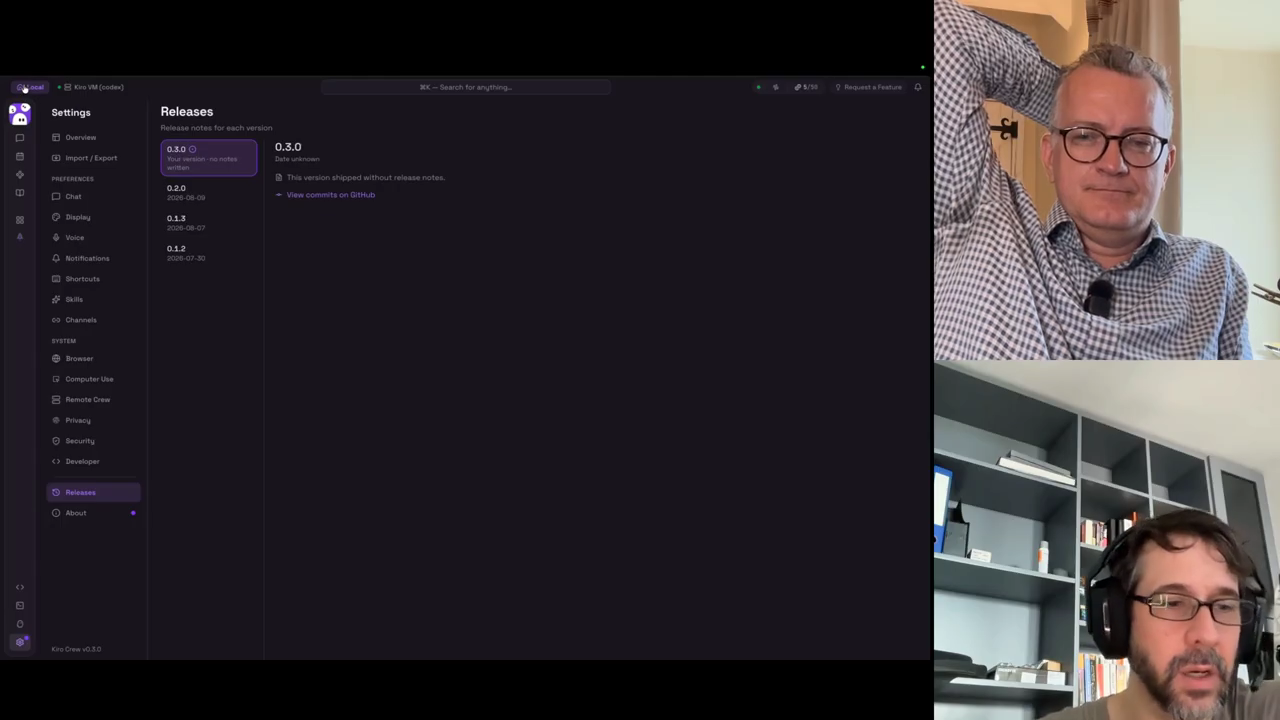
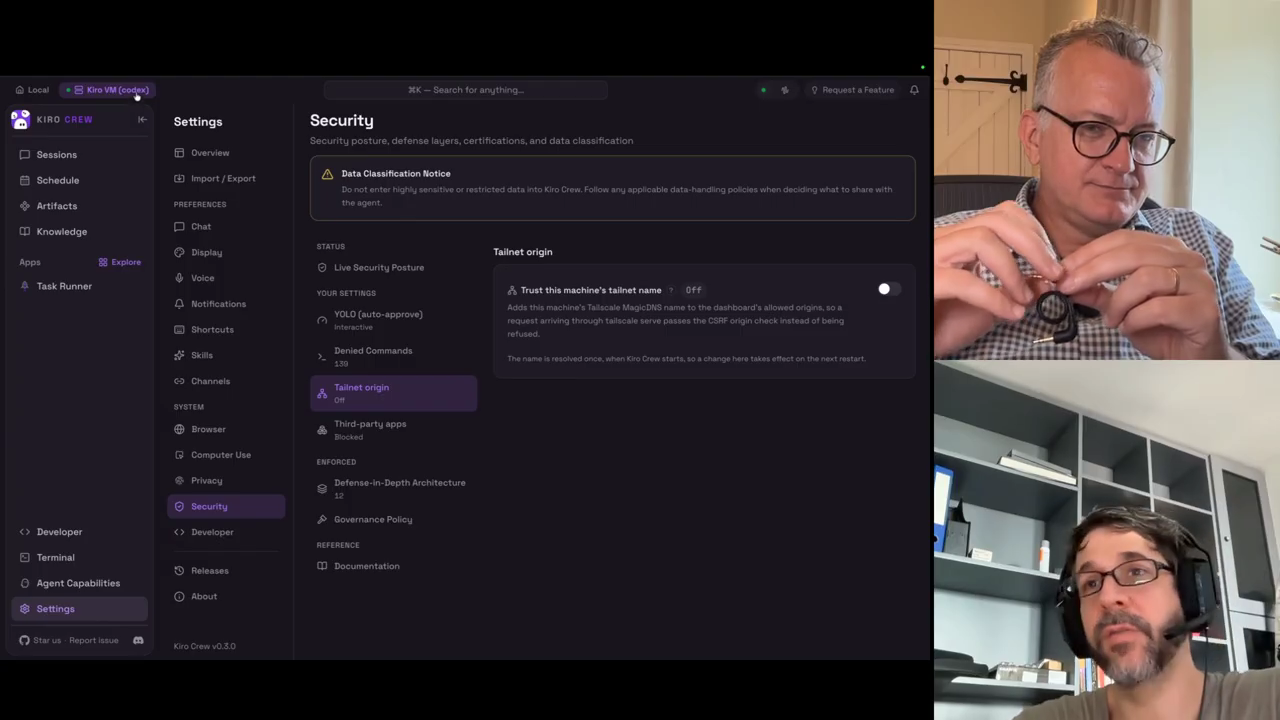
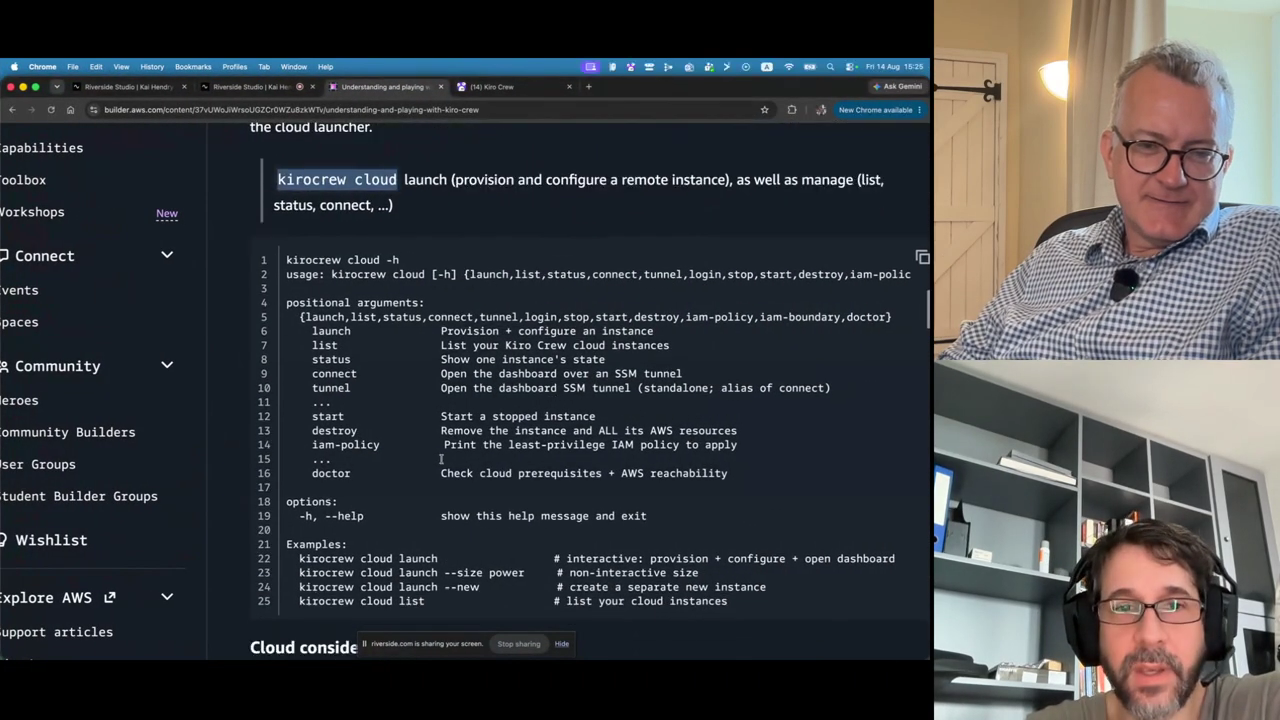
Kiro Crew is demonstrated as a local Mac OS app that bundles a Python gateway, a single‑page React UI and connects to a local CLI (Kiro/Kiro) via the agent client protocol. The gateway can run locally or be bootstrapped into the cloud as a separate remote gateway (via a crew cloud subcommand) so the dashboard shows sessions from that instance. The UI supports sessions, scheduled tasks, artifacts and a knowledge/memory layer; remote instances are reachable over SSH/SSM tunnels and can be scaled and stopped via EventBridge.
Memories and embeddings
The hosts compare simple markdown-based memories with vectorized memory systems. Embedding models convert text into high-dimensional vectors that get stored in a vector database for semantic lookups. “text becomes tokens tokens becomes a vector that gets stores into a vector database for semantic lookups.” They report practical limits with file‑based memories (size constraints, write failures) and describe running local small embedding models (e.g., Llama cpp) plus a Postgres-backed vector store for richer recall, cleanup and relevance tasks.
Deployment and cost tradeoffs
Running a full cloud instance with local embedding models and memory systems is resource heavy and can be surprisingly costly because of components like NAT gateways and private subnets. Quick experiments on EC2 can cost only a few dollars per hour but a continuously running private instance with networking can approach ~$50/month depending on region. They describe mitigation strategies: scheduled scaling, choosing cheaper regions, and lightweight NAT replacements or iptables-based NAT for dev setups.
Extending via forks and ACP gaps
The presenter explains they forked Kiro Crew to swap the default CLI/backend for a different model backend (Codex/CEX). That exposed protocol mismatches in ACP: some gateways don’t advertise elicitation (ask‑user) capabilities, causing structured UI interactions to fail or return 500 errors. Workarounds include presenting a facade that translates or surfaces usage and elicitation as simple option chips in the gateway, capturing usage as a side channel, and adjusting capability advertising. The fork is public so others can build a custom instance now; if accepted upstream, these changes could be merged into the main project.
Model: openai/gpt-5-mini
Transcript (auto-generated from YouTube captions)
How are you?
>> Yeah, good. I've been on holiday this
week, so I've but I've just been at
home, so I in the end of the day, I just
just been trying to spend time with my
kids and
not too sure I'm doing the greatest job.
I just I just end up arranging
activities and then watching them play
from afar.
>> How old are they?
>> 10 and eight.
>> Oh, that's nice. They're close to each
other. Um
>> yeah,
>> and they can entertain themselves.
They're at an age.
>> Yeah, it's it's quite good. Yeah. And
then and then um the big news is that my
c my sister and her husband's moving in
here and they're going to live next to
us so that they got two cousins to play
with all the time.
>> So I guess I don't need to be around
anymore. I can just fully devote myself
to AI. Oh my god, that sounds so I mean
not not at all what I'm doing though.
>> No, no, no, no. You got the balance.
You've got the balance just right.
>> My son is 17 and my daughter is 12. No,
10. Uh, she's 6 years younger, so she
must be 11. Yeah, she's going to be 11.
>> Yeah. And so it's a bigger gap and
there's a bit more a different power
dynamic. Like he acts like,
you know, cuz he he feels like I spoil
her because she's my little princess. So
he's there to set things right, you
know, to be a bit more disciplined when
she's, you know, taking all this for a
walk. I don't know if you can see this
ring like in in the reflection in the
glasses.
>> I can actually. I can. Is this is this
your your light or something? It's this
feature on when I got this MacBook and I
joined the meeting. I wanted I was in a
dark room and it says said the the light
is bad. Do you want to turn on the c the
ring camera? And I thought it was a
Microsoft Teams thing and I was like
I'll figure out how to turn it off at
some point. But it's everywhere and it's
annoying cuz it's and I haven't figured
out how to turn it off yet.
>> I should ask Claw to turn it off for me.
>> Yeah. So you're in a different room now.
>> Yeah. So my I had to give my
>> son's room back so he could spend some
private time. He can get some some
private time.
>> Why you say it like that? [laughter]
>> Well, yeah. It's It's been good to
disconnect for a little bit, but I still
like read hacker news in the morning
like a lunatic.
Funny enough, uh, Paul Graham
was was talking about that one problem
that he felt that was not solved with
white carbonator is is how to balance
family life with with startup culture.
Family life, startup culture. Yeah,
there doesn't seem to be any way of
making those two mix very very well.
I I mean I personally know at least a at
least a couple of people that have have
thrown themselves deep into tech and of
course they don't have a family I would
say
>> which I think is a bit of a shame. I
don't know if you have got any of those
examples to hand but I know yeah I
definitely know a couple of people who
went deep. Yeah, I aside from myself, I
have a family, but
>> just
>> cuz they're quite accommodating to to to
me being so like honestly it was
supposed to be temporary right after co
you know it was supposed to be like you
know just you know lock in for a while.
It's been five years now um to to
prepare for the future because you know
co made remote work possible and
>> exactly
>> it allowed me to try and put away as
much as I can and retire early except
I've been doing that for 5 years and I'm
not retiring early. So
>> yeah, I yeah, like with AI and the
investments I'm making, I feel like
I'm going to be working to the day I
well until the into retirement age at
the very least. But yeah, I I feel the
pressure with AI. I mean, I do enjoy AI.
It's just that of course there is there
is like an under an undertone an
underlying pressure to to stay relevant
and
and and
stay ahead of the pack and it's yeah it
is a bit it is a bit much.
It is a bit much but like got to keep on
doing it and try and make it fun. So
hopefully you have some fun things to
tell me Vincent. Otherwise, I'm just I'm
gonna sign off now and spend some time
with my children.
>> Stand still and contemplate or decide
like make sense of what we're doing and
let's just dive in and focus on what
what what other fun stuff we read about.
>> Yeah.
>> Never stand still. Never look back.
>> Got to keep it fun. Yeah. Don't ask uh
you know, ethical questions.
>> Yeah.
>> Oh, I I got into I got into a silly
debate yesterday with one of the people
I played tennis with at I'm a proponent
of having of building solar farms. I
don't know what it's like in Vietnam,
but like this there's been a bit of a
buildout of of zero my god, what's it
called? Zero whatever um zero footprint
energy, whatever it's called. So
basically solar farms in in England and
there's like a real opposition to it
because like oh what about our food
security? But like I can't help but
argue like isn't energy security
slightly more important?
>> Yeah.
and saving the world. Anyway, okay,
those distractions aside, Vincent, you
look a bit drained and distracted. Come
on.
>> Yeah. No, let's let me share the the
screen. Entire screen.
I'm going to do it on the screen that
has the Coo massive
um inception right there.
>> Okay. So, you're back on the hero stuff.
>> Yeah. So I'm actually running like a
local build um where I did a couple of
really fun things. So my version might
not actually work properly uh because I
went quite invasive and I mean Kiro Crew
is kind of AWS
openclaw/harmus
solution for enterprise right and since
they made it public they now are also
sharing about how quickly it evolves
similar to openclaw or hermas you know
having agents on their own contribute
the features and then they have a whole
testing harness and um review harness.
So this is actually very interesting to
to see and also to
>> there's a link up with the the AWS bench
that we were talking about last time.
Uh
maybe because I do believe they they
they do benchmark hero's capabilities
on specifically AWS type of um [snorts]
you know problems. Do you want to focus
on that first or like let's just look at
>> So this is called Kiro Crew. I kind of
>> Yes. So there's a big difference here.
Maybe you see it at the top. I am
currently running the Mac OS app and
that comes bundled with a gateway that
then hooks into your local MacBook um
where you will have Kiro CLI
authenticated and the Kiro CLI and the
Kiro IDE which is the original IDE they
launched with specdriven development
last year has all been rewritten to work
on a single harness a single bankant and
it uses the agent client protocol to
connect everything. So you get you get
all of these different experiences um
and with with like one like if I go into
the builder article I wrote
>> I noticed that AWS was contributing to
the whole MCP thing and making it easier
to
>> so this is the agent client protocol not
not MCP
>> agent client protocol okay
>> yeah it's not the model
>> it's not the model context protocol so
what what Kira crew is here. Um it's a
it's a gateway and um
>> very much like how how um you know
OpenCloud originally was a gateway to
Telegram or WhatsApp uh for you to talk
to your um agent um wherever it ran like
maybe it's your um you know codec cli or
your Claude Code you know originally it
was open claw claw like cloud cloudbot
it was related to Claude Code right until
anthropic shut it down and then codex u
you know openai hired hurts Peter and
anyway this is the same thing right it
starts as a gateway and the gateway
connects to MCP tools and this is uh the
dashboard app um this is the actual
dashboard app
>> you can also have it in your browser so
this is the dashboard app running in the
>> I was going to ask is there a mobile app
>> um potentially I'm not I'm not sure I
haven't looked into that uh but anyway
so so this is the whole component layout
which I think is a little bit murky when
you first inst install it and you don't
know like when you first download or
built the the dashboard app on your
machine, it's actually running on your
on your laptop and this this Mac OS app
right here
>> comes with sessions to for chat schedule
um everything is is is there and it runs
on your laptop which I did not like I
don't want this on my laptop I wanted to
>> feel a little bit like an antiattern you
know when people install openclaw on
their their Mac minis and like yeah take
over everything.
>> Yeah. So, so that's where I got confused
and that's where I really like this
diagram because I didn't know what the
components were within and uh but the
most important part is that this
dashboard app comes with like a bundled
gateway uh and then it connects to your
Kiro CLI on your machine and then if you
authenticate Kiro CLI or you use Kiro
before it will inherit everything you
already have there. So, um then it it's
a little bit like herder what you
mentioned you know it gives you an
overview of all this of all the
sessions.
>> Where does this gateway run? Is this an
AWS thing
>> here? Um, let me just
>> This is you get like all your chats of
your your local session. So,
>> when you do the gateway in the Mac OS
app, it's it's basically just it talks
to your uh CLI on your machine using
ACP, right? Agent client protocol. Okay,
cool. So, um Oops. Yeah. So, so that's
where does the gateway run on your
machine?
Yes, I'm going to say it the third time
now for you. Okay, the local bundle.
This thing runs the gateway inside the
Mac OS DMG. If you build it, it it
bundles the single page app like a React
vit and the gateway which is a Python uh
gateway and that connect with the
protocol to your KRO on your machine.
Okay. So, this this Mac OS app
>> runs the gateway.
>> Got it. But then
>> and now let me let me tell you one more
thing. One more thing here is that this
particular gateway has a remote crew
capability here.
>> Ah
>> yeah so with this remote crew you can um
if you use the Kiro crew CLI you can you
have a cloud subcomand. So actually
that's um the next part of this of this
article here uh is that you can set up
remote crew and you can run Kiro Crew
cloud um to manage remote instances and
and that basically bootstrap a cloud for
template into your AWS account and spins
up an instance with the gateway as well.
So that's a separate remote gateway that
you then that you then connect to. Okay.
So that's
>> that's a separate machine. You may run
the Kiro CLI on it. Then you need to
authenticate your Kiro CLI and um with
the device mode authentication on your
subscription and then you you get um you
know [snorts] Kira access and all the
models that Kiro support. Um and you you
you get the same thing here. Um sorry
you get the where was I?
Uh where is the app? Oh, here it is. So,
so you get you get you can connect. So,
let let's let's say you spin up one and
then you can connect here and then it
will pop up at the top and now you have
uh all of the chat sessions you have
with that instance over there
>> and it can run um you know you can set
up tasks to run on on a on a schedule.
So, the thing runs on its own
>> and um I mean I guess this is like what
you would get if you runs the Hermes app
which I never ran. So um I have a Hermes
VM and right now the only way I interact
with it is through the Discord channel
and it's not a very nice experience,
right? Every interaction is either
through a Discord uh thread um and and
in this case actually I get a nice UI
and I do think Hermes has this as well
but this is the AWS version. I I've
shown you this before, but I I use this
thing called command and control,
which has a mobile app and a web page
where I I I I connect to all my my
different uh
Okay. So, so this this this is confusing
because I have another sessions here
settings here and then here I don't have
the remote crew uh option because this
is a remote gateway already. Um, and
what's very interesting is when you're
developing and you're making changes to
the gateway and then it goes and deploys
the gateway into that remote instance,
you have to like reload this whole pane
because this whole pane is served over
SSH or over SSM via private tunnel. So,
so this actually is a separate instance
of a gateway running separately that you
that you get over um over a tunnel like
an SSH tunnel.
>> It's very interesting. Yeah. So, okay,
>> that that was interesting because I was
building I was re uh changing things and
and and reloading the app is actually a
little bit unintuitive because I was
like do I need to rebuild my my local uh
Mac OS app and and uh cloud was like no
uh the whole app loads over SSH
remotely. So once the the whole um asset
all of the assets have been downloaded
over SSH then it runs very quickly. Um,
but the first time it can take a while
if you run a a crew somewhere in in
Singapore and you're in Vietnam and your
connection is not great. Um, then then
the first time loading then is a bit
slow. Uh, but once it's loaded it's it's
pretty fast. I
>> I like the look of this whole ecosystem.
I guess I guess this is like remote
control claw remote control on steroids.
I guess we're going to see more of these
sort of buildouts, right, where you you
you able to see your a number of agents
in essentially one place, right? Yeah.
And there's also the ability here. Okay.
I I want to really go into the features
that this thing has because it has a lot
more like my experience setting up
Hermes VM and then coming into this um
is like holy, you know, sword. This is
them um packed with features. Um you I
haven't tried this yet, but right now
this remote uh instance is actually a
virtual machine on my desktop at home
only accessible over LAN. Uh I'm very
excited to enable like tail net uh or or
like tail scale and then being able to
connect to it remotely. Um
>> ideally over a control and open claw
have that kind of up the box.
>> Uh yeah sure. Now let's go and talk
about some of these cool things here
like knowledge. So I don't know if you
set up like I don't know about open claw
but Hermes when you set it up one of
the first thing you have to do is like
what is your memory system it's flexible
right you can choose which one you want
you can use hindsight.ai AI uh you can
use another like you ideally nose knows
no new uh the the company behind Hermes
wants you to use their control their
cloud to use their services right but
you are freeing one I don't remember
choosing I don't remember choosing one
but was
>> yeah soh yeah it also can use markdown
files so on disk it will have a a soulm
and maybe some other uh markdown files
but what I found was that it very
quickly hit a ceiling on like there are
restrictions on the markdown on file
size and also when it tries to save
memories it writes to down to markdown
and then it hit that size limit. I
basically used Hermes without really
knowing what what it was doing for a
week and then I asked Sonnet what are the
common failures what are the errors that
you see in the logs and one of the first
things Sonnet uh highlighted or cloud
code highlighted was that well it's
having a lot of issues writing memories
like it's hitting markdown file CS and
things like that so the memory system
was the first thing that I replaced uh
within Hermes.
>> Okay.
>> Yeah. I feel like I'm being lazy because
I've not looked through the Hermes logs
to be honest.
>> Yeah. So, so, so what that meant for me
was that first off I wanted to figure
out what does a memory system provide
and like how can I use it and I started
to learn a little bit more about
um like on the memory side of things
there's information about how do these
memories uh link together
um you know semantically you know recall
rate like when were the last recall are
they still fresh there's a lot of uh
aspects about a memory system that you
don't really want to bother with, right?
But but I had to learn it because I had
to like understand a little bit better
about Hermes and setting up the memory
system. So I I'm running on the desktop
a complete full stack of uh containers
which uh uses Postgres vector
embedding. I have a embedding model that
I had set up with my GPU and then you
come to Kiro you install it and
everything is there right I'm trying to
find now but in terms of like if I look
at the memory configuration it comes
with a local embedding model where is
the memory
>> what does what does embedding mean here
>> yeah so embedding models are basically
converting text into token into into uh
token arrays right so um a vector so so
text becomes tokens tokens becomes a
vector that gets stores into a vector
database for semantic lookups.
>> What what's the benefit of that?
>> If I say cat and um it can it can relate
to house cat even though they're not
lexically close the concept of cat dog
is is is semantically close to house
pet. So converting a word like cat or
dog to tokens and then calculating uh
using an embedding model. So you have to
use the same embedding model that you
that you um store the data with the
vectors with because it consistently
converts all of this. It's it's a small
open uh weights model that um gets text
and then converts them into vectors and
then those vectors they have like
similarity. So cat, dog and house pet
all have very close semantic meanings.
So their vectors will be very close to
each other. So if you do you can imagine
like if you if you imagine two
dimensional vectors you can calculate
the distance between them easily right
but these are vectors with like 1,024
dimensions it's very hard to imagine how
uh you know but you can calculate the
similarity between them. So, so that's
what an embedding model does and it
means that if you have some type of
semantic um you know lookups you need to
run an embedding model uh when you get
text store it into a vector database and
then when you want to query the database
you need to um embed that query send it
um to the vector store to do a
similarity lookup and then it's going to
return facts about that are related to
that query. So embedding is very
important and running embedded locally
on your machine is kind of it's
happening. You have a lot of small
little um models that are running on
your machines already. I Claude Code
ships with the local um model. It it it
it runs a local model to do the auto
mode classifier. I'm pretty sure. Oh
actually no
>> actually no because because when you
sometimes you get an error saying the
classifier hits an API error or
something. So it is it is remote.
>> Yeah it is remote. But the on the topic
of memories. So
how do you maintain your memories? Cuz
like markdown is cool because you can
just like SCP your your your markdown
into a new machine. How do you maintain
your your embeddings database here? It
doesn't. So ideally you don't right like
>> so if ideally that's where where these
these memory systems have all kinds of
like capabilities and cleanup jobs and
and and and background functionality to
maintain the memory right so I don't
like with hindsight I don't even know if
there's like a a chrome running to like
identify any stale memories and and re
reorganize the memories to see what's
what's relevant and I al honestly don't
really want to worry too much about it
right um but you see how like that you
miss a lot of that when you have simple
markdown on disk, right?
>> Yeah. Yeah. This is this is why I kind
of I I always kind of gravitate back
down to markdown because I can
understand it in my human monkey brain.
>> So, here it is. Embedding is using llama
cpp. I want to find because it actually
lists out the local models that that KO
ships with and it runs. So, I can't find
the model. I think it's in security. If
I go to settings and security, I think
the auto mode classifier
um is somewhere in the settings. So,
it's it's very interesting to go through
and and and figure that out. Uh but I
think it runs at least two or three.
>> But the next burning question in my mind
is what's the the multiplayer aspect? Is
it just through just are you supposed to
is one person supposed to admin this and
then your team is on Slack or something
or or was there some other usage
paradigm that's supposed to happen here?
>> I do know that Kiro um when you use it,
it has this artifacts capability and I
know if you look at the artifact, you
you can leave comments on things. Um,
and I do think that this comments thing
I feel like that's really something that
is a multiplayer capability. Um, but
>> so that means every everyone in your
team runs
>> I don't know if you can like I don't I
guess as far as I can see right now the
gateway doesn't have like a multi-tenant
or multi-user um capability. When I look
at these and I want to click publish to
share it with the team, it's going to
use a skill to if this is a box running
in my AWS, it's going to try and publish
it through like a cloud front or S3. So
the cool thing is that everything is
yours, right? If you use Claude Code and
you create an artifact and then you it
gets like a cloud hosted URL publishing
it is all controlled by entropic. This
is all your box, your memories, your
your S3, your account.
>> The power of AWS, they can sort of
connect the dots, can't they?
>> Yeah. And then
>> with your
>> with this with this capability to just
run one command Kiro Crew cloud and then
you can just launch and then you you
consider do you want light balance but
you do realize that you need a
significant amount of um CPU and memory
because you're running all these local
embedding models, right? you know, and
you're running a whole memory system and
and and more. So, so the light one is is
not cheap.
>> And I guess it's not serverless. The
thing is running all the time, even if
you don't use it, right?
>> Even worse, I I went for the full p
private uh instance. That means it was
running on a private subnet, not public.
And that means I had to have a net
gateway. That means uh I get a whole
bunch of extra costs, which is already
$50 a month for like a hobby or a single
user. That doesn't make sense, right?
So,
>> yeah. Yeah.
>> Yeah. So, so I did set up scheduled
scaling um which basically with
EventBridge uh stops it at night in the
evening and then scales it up again in
the morning.
>> But um but still it says the net gateway
is really the the cause of your cost.
>> Oh, this your own blog is it?
>> Yeah, this was the blog post I posted. I
have a I I want to post four parts. The
first one was this initial cloud-based
exploration. I did the same with Hermes,
right? I just um you know spun up a
Hermes instance, looked at how it felt,
looked at what I could do with it,
realized it's going to cost me $50 or
more dollars a month. Definitely if I I
wanted to have a memory system, you
know, I wanted to have like the
hindsight and all that uh fire crawl for
for web search.
>> Wait, why is it costing you $50? You
don't have a you don't have a Pi or
something? You don't have a VPS? What do
you mean?
>> Um yeah, this a different question. I'm
talking about exploring and and getting
started quickly. Um, I didn't have like
I I I didn't have like
pie lying around or anything like that.
>> I see.
>> Um, so I wanted to quickly, you know,
try try this out. And and my quick start
to try anything out is, you know, spin
up an EC2 instance, do a bunch of
things.
>> If I don't like it, tear everything
down. Uh, if I keep if I want to keep it
running, it's going to cost me at least
$50 a month. Um, but of course if I run
it for an hour or two, it's going to
cost me maybe $2, $3 for an experiment.
I don't have to go and buy a a pie for
that.
>> Okay. So, um,
>> N gateway and also funny um, because
again the the the information for this
blog post came mostly from cloud, but I
actually rewrote it and wrote it all
manually. I mean, large parts of it,
most of it. [laughter]
Why? Why did you have to rewrite it
manually? Just because it
>> cuz I wanted to make sure it wasn't to
AI slop and it was actually um you know
>> you tightened it up.
>> Yeah, I tightened it up. Uh but the
funny thing is that cloud is like Yeah,
but you're running it in in in
Singapore. In Singapore, the net gateway
is costing you $40. The savings that you
have on a nightly um if you scale it
down night nightly is only three like
$30. But if you would switch everything
to the US East, you would uh already cut
the bill by $10 without even the up down
schedule, which is a significant
difference, right? If you if you put it
in proportion that way. I thought that
was pretty interesting finding.
>> Yeah.
>> Yeah. I I'm I'm almost surprised how
expensive the net gateway is. And it's
it's just been a meme for a decade now,
hasn't it?
>> Yeah. So, there's two things I want to
follow up on this article. It's to use
fck-nat, right, which is the um
>> Oh, yeah. You told me about that. You
told me about that.
>> Yeah, I use it in in dev environments at
work. It's really cheap. Um, it's a T4G
nano because ultimately if you don't
need a high available multi- instance
autoreovering high high throughput net
gateway uh you can run on a single NAT
and set up um what's this called? Net is
really just a couple of uh
>> IP tables is nothing.
>> Yeah, exactly. You can just do it with
IP tables.
>> If AWS announced,
>> that's great.
>> That Net Gateway was being folded into
something and you wouldn't be in charge
for it. It would be so great.
>> But anyway,
>> yeah. So, great thing about Riverside is
it connects. It records everything
locally. It's just going to be weird in
the edit. Anyway, [laughter]
back back to Kiro Crew. So, already like
this is great. Like I told you about all
of the capabilities comes with out of
the box, but how does it feel to
actually use it? So
I I tried some things out. For example,
I was uh I was on a call. Let's uh close
the sessions. Um and I wanted to ask a
question about um agent core some
capabilities there. So I was asking here
it gave me some diagrams but then I
asked it to to create
I hope that it would automatically
create like I wanted the sequence
diagram because it shows these things
and I want it as a sequence diagram. I
was hoping it would create an artifact
but it split out a bunch of mermaid. I
said now please just create a proper
artifact and um
>> what's a proper artifact? HTML basically
I suppose. Yeah, the same like if you
talk in Claude Code and you say create an
artifact and then it opens up your
browser with that HTML. Uh
>> I don't really like mermaid diagrams but
oh well they could be just
>> yeah well even Claude Code is doing most
of it uh when it creates the artifact
it's using u mermaid or other diagram
tools under the hood um but anyway so
while I was talking it created these
diagrams um and then you can ideally
easily share them uh with your team
right so this was pretty cool like I
found that a very nice experience uh
it's all locally um on my Yeah, those
look good. Those look good.
>> I click on artifacts. I can see all of
the previous artifacts it has created.
Um, for example, here
>> we can do better in this regard.
>> Well, yeah, but remember that here,
okay, this is one thing I haven't told
you yet. I'm I'm running this all off um
my local fork which uses my ChatGPT $20
subscription. It doesn't like it's not
Claude Code. I'm not paying uh a lot of
money here. Uh basically my my family is
using the the ChatGPT app on their phone
and they're very happy with it. Uh and
I'm using it to generate you know code
on my my machine.
>> So that's what you did. You you
basically forked Kro so that I can work
with you with your own personal
>> GPT subscription. So, if I go here in
settings and I click on uh usage
overview here, I can see here my uh it's
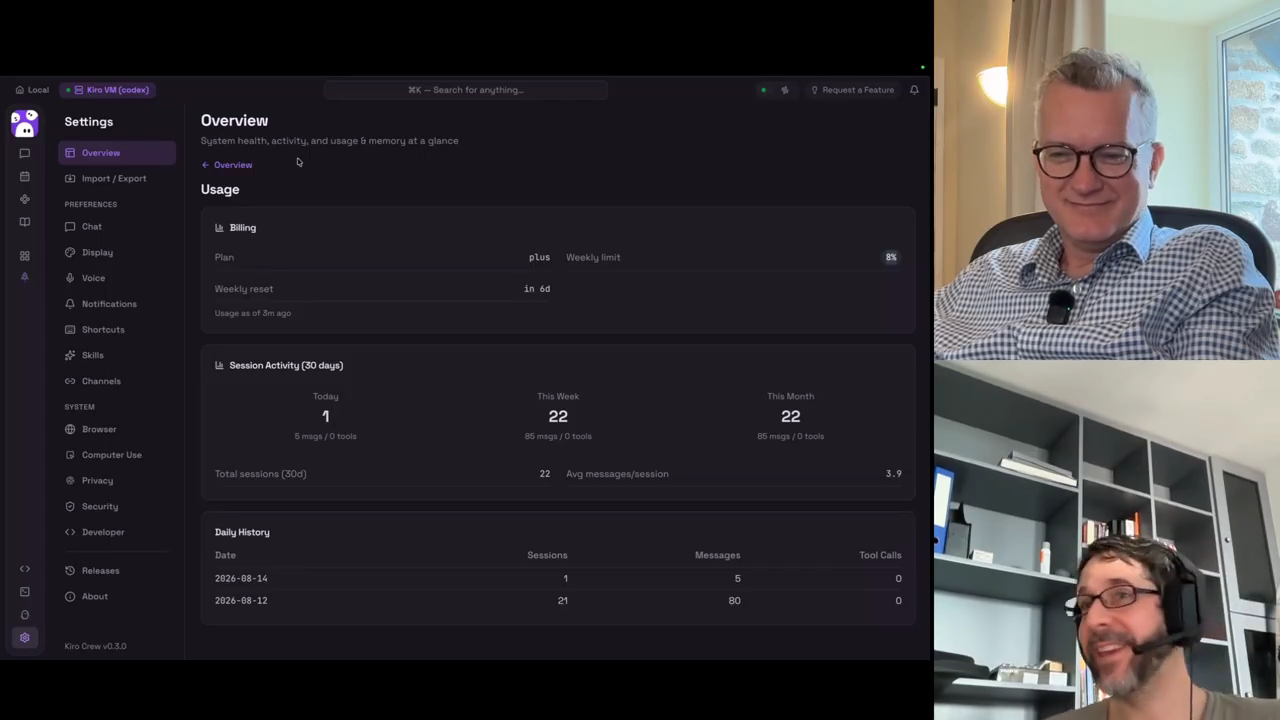
my GPT plus and weekly reset is in six
days and I've only used 8% of my limit
>> um how many chats I have. So, all of
these statistics are are my ChatGPT
subscription and and I think this is the
greatest thing about Kiro Crew. Um if
you go back to that diagram here, where
is it? It's
>> so the whole thing's open source is it?
It's fully open source Apache 2 and it's
using this ACP protocol or agent client
protocol which means
>> they ship it with Kiro but you um can
contribute your own. So what I did I
replaced the Kiro CLI with Codex and
as a result my whole Kir crew is using
CEX under the hood instead of KO. Ah,
now I understand why you've been excited
to tell me about this. Yeah, that does
sound quite cool.
>> Yeah. So, I've I've I've showed it to
the team because when they announced it,
they said that um this is ACP, so you
can use any uh compliant and and
somebody asked I think like can we
contribute our own other than Kira? And
they said yeah. [laughter] And I was
like okay you you said we can. It wasn't
me. Somebody else said, so I said uh to
Fable, what would it take to rewrite
this thing and not use Kiro uh but
instead use use Codex and use this ACP?
So I wanted to know and it's actually
very interesting because this agent
client protocol um is a way of like the
client here is the gateway, right?
Gateway is the client to the agent. So
so the gateway advertises capabilities
of what it can show to the user. Um, for
example, elicitation. When I ask a
question, um, it may ask like when the
user asks a question through the
gateway, the model might decide that
it's better to get like, um, you know,
feedback before it answers a question.
So, it gives you a couple of options,
right? Um, that's that's a ask user
question tool in in in in um in cloud
code. Um, so this elicitation is a
defined capability in the agent client
protocol. So there's a difference
between the capabilities of Kira and
Codex. So Codex implements elicitation.
KO does not yet implement it. Okay. So
what does that mean is that the gateway
uh currently advertises that it can
display. It doesn't actually eliminate
elicitation as a capability. So, Codex
assumes that the gateway can can
display. That means that Codex will come
back to the gateway and say, "Show the
user a cart with three options and the
gateway um didn't say that it doesn't
support it." So, um it actually right
now just responds with a 500 like
internal server error. Um it actually
responds with a reject code which keep
which Codex inter interprets as it was
a security rejection and it cancels the
request. So that was kind of like the
unexpected um you know kind of problems
you run into because of um that was one
thing. Also the whole usage like
dashboard that I just showed you it
didn't work because the way that Kro ACP
um sends back usage information is
different from the way that Codex does.
So I had to like fable highlight it
exactly like where the problem lies like
the the the Codex back end is sending
the usage with every message and I said
like how about we we create like um um
what do you call this a facade or like
an interface on top of it. So I'm I'm
using Codex ACP under the hood but I'm
exposing it as with the same
capabilities as KO like Codex says I
can't show you usage. So when you go to
usage the dashboard is empty but I said
hey CEX there is usage information just
present yourself as the hero usage and
and under the hood it actually you know
when codex sends them the message it it
captures the usage information and
exposes it uh as a side channel so it
still works. Yeah. So that's the kind
the kind of cool stuff that I learned
doing this, right? Because yeah,
obviously I don't want to maintain a
fork like I was actually thinking I set
up this KU instance to to automatically
maintain its own fork and every time
rebases on top of the upstream uh and
and and and things like that. But uh
thankfully the the AWS team is actually
living up to their promise and um and
they're like you know evaluating because
they're also saying why don't we just if
you do the Codex authentication you get
a bearer token. What if we just like use
Akira ACP um but you use a Codex like
bearer token that you get through the O
flow um and that might be another thing
that you could do instead of just
replacing the whole ECP back end. I just
did it for my like my own exploration
like what is HCP? What is the impact?
How does that you know manifest itself?
It was very cool.
>> Yeah, this this sounds really
interesting. Yeah, thanks for
introducing me to agent decline
protocol. But wait but wait a minute.
Um, sorry Vince, I was just daydreaming
there in about using it myself. So you
said you didn't want to maintain a fork.
So So going forward here, if I wanted to
get started using my own um Codex or
clawed subscription, what what changes
would I need to make on on the on on Kro
to unlock that?
Can I just patch it using your thing or
do I just launch Fable and ask it to
make a fork?
>> So, I have a public fork um that I've
shared with the team and um shown them
what works. I identified the gaps um you
know where where the Codex ACP protocol
and the Kiro ACP protocol did not match
up and the ways that I worked around it
so that I make things work and um my
fork currently is public so anyone can
just build a copy of Kiro Crew and run
it with with Codex uh if they want um I
would not recommend building a co cloud
code ACP in fact there is there is a
bunch of code stripped out so internally
within AWS they they run kir crew with
Claude Code ACP I believe. Um but they've
stripped it out because if you do that
on a subscription you will get your
account banned. Um so but but OpenAI it
tells you you can do it. So if you want
to run Kira crew with Codex ACP today
you can use my fork build your own
instance and use it. Hopefully in the
next few weeks if if they if they do
believe this is a good addition it might
get merged upstream right and then you
just have a single Kiro crew and then
you can choose either Codex or Kiro
>> there's definitely a gap for the market
I mean I was always kind of assuming
that open code or some somebody else was
kind of filling it up but like if if AWS
is is pushing is is publishing good
stuff with the Apache 2 license
I can't help but I think that it's it's
on it's it's a very good game plan.
Very good.
>> I want to show you this elicitation
thing um because this the fix was very
interesting actually and you can see it
at work here
>> rather.
>> Yeah. So instead of showing a card here
that that this is the realitation. So
normally Codex would reply with like a
um a schema of what should be in the
form. It should show you the options and
then the user can click on one of those
options and then the option gets fed
back into the gateway gets goes back to
Codex. But it's not supported. So
what's what's happening right now? I
smell something weird like [snorts]
smoke. I hope I'm not on fire.
>> Um anyway, I'll go check in a minute.
It's [laughter] like this it's like this
meme where the guy's on fire and he's
like sending message fire.
>> It's it's always a good idea to nip the
fire in the bud. Just go and have a
look. Christ. Maybe it's the car that
was on that the car alarm and maybe it
was on fire. Maybe that's why the car
alarm was going off. [laughter]
>> It's fine. Yeah. Anyway, so it's fine.
>> What what what's happened the fix that
that Fable suggested was just for the
gateway, you know, remember the gateway
is the client here to just not clearly
advertise that it does not support
elicitation. And when Codex knows that
it does not support elicitation, but it
wants to get feedback, it actually sends
back a structured response um with just
a list of options. And that's what
happened here. So I was like, I want to
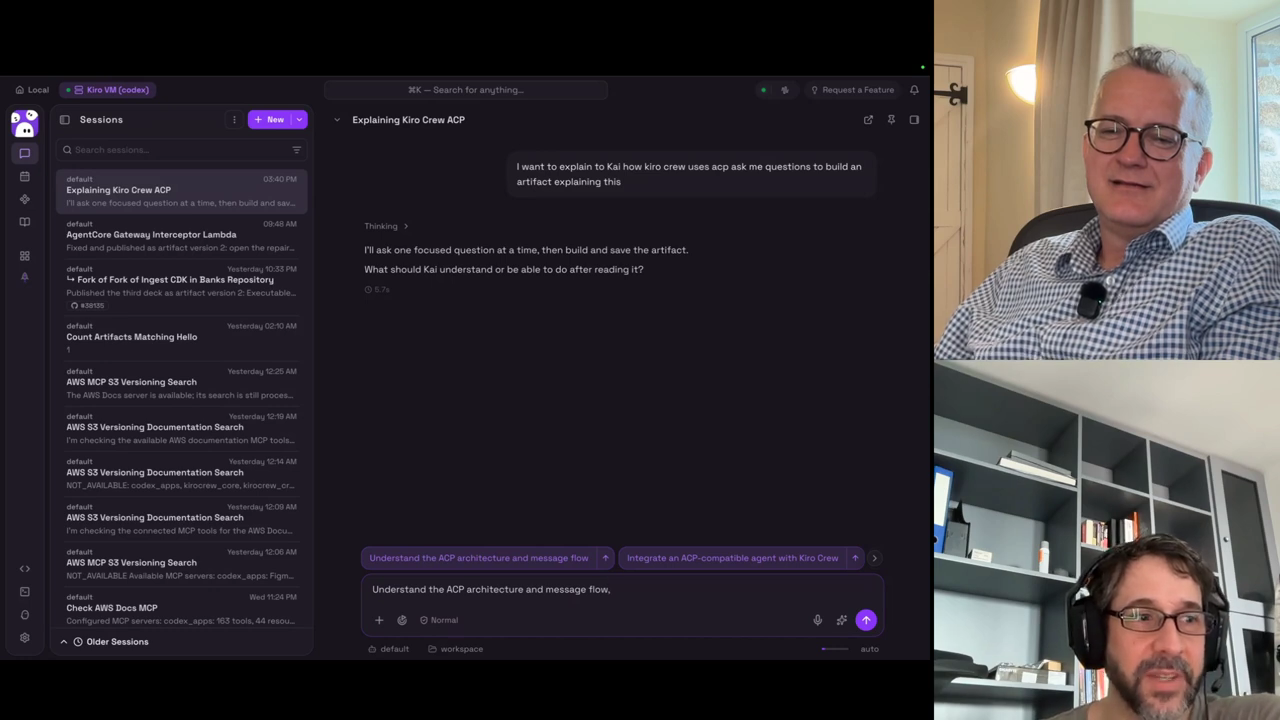
build ask us a question like I want to
have that nice interactivity of options
>> and uh and then what I realized is
>> I didn't have to build it because the
gateway is able to show these options
right here as little chips above my
chat. Can you click it and and add
notes? Oh, I see.
>> So when you when you click it, you can
even click both of them and then it go
they go inside here and then you can
just modify.
>> Interesting implementation.
>> It's a very Yeah. And I thought like
this is better than than than ask user
question, right? I was trying to build
something I knew. Um but there was a
better pattern that already worked. So
that's kind of also something I learned,
right? Sometimes you got to really use
the system and understand how it works
before you try to make it work exactly
the way that you know.
>> Yeah. Yeah, I mean it is strange to
think I mean we've talked about ask
question tool
a number of times
but it's one of those things that we we
will keep on revisiting I suppose
because the way you use it has so many
nuances and uh I don't think we've even
touched on the multiplayer
u aspect really because ultimately the
the ask user tool probably is like one
of the major the
decision points in your decision tree
about how you get to your end product or
somehow
it is quite fascinating to see where
those those turns were made. Yeah. So
here is the interaction and maybe you
can say well this is like what the chat
GPT app gives me right but again it runs
on your box your memory system all your
data. The second thing is you have the
context window, you know, tracer here.
You can choose the models and because I
build codecs, I have all of the CHP
models.
>> Can you show the tracer? I'm just
curious because I' often find the
tracing implementation is
>> what tracing
>> sometimes not what I expected to be.
>> What is the tracing?
>> Oh, like when you see the the actual
calls and uh the thinking and things
like that.
Oh, maybe it's not there. Ah, you mean
the thinking the thinking steps that it
did? Okay. Sorry, I thought you wanted
to see like telemetry. So, is there some
thinking? Okay, there's no there's been
no thinking on this chat, but let's go.
What should the agent elicit from the
user uh buying a car options? And let's
stop with the questions and have it
build an artifact.
Should the walk through expose the
protocol? Enough questions.
Build the artifact. Oh my god.
>> [laughter]
>> So yeah, so here's a thinking right. So
you can see the thinking box at the top
here.
>> Pretty cool.
>> Yeah. And then this is the this is one
of the main features uh from Kiro Crew
as well uh which is like security.
There's this embedding model and
autoclassifier. Sorry not embedding it's
an local autoclassifier. So right now
it's it's um it says you can say trust
this particular action or trust all. I'm
just going to go by the most secure way,
which is trust everything. [laughter]
[snorts]
>> This is interesting. It's really
interesting.
>> Yeah, but like if you only managed like
if you only used um Hermes through
Discord like I have, this is a breath of
fresh air. And I haven't even touched
and like because of all of the
capabilities that it comes with, right,
with the taskr runner, the the knowledge
base, the schedule, and then you have
the whole apps ecosystem. So they have a
whole SDK and I haven't tried any of
these but you can have um like there's
extensions where you have more than one
agent and so you can have a whole um
animation and a world where you see like
oh suddenly your review agent woke up
because a new issue has been raised or a
new pull request has been raised and you
see that agent moving towards a desk to
start reviewing the things like those
are the things that people show and I
think this is a bit stupid but it looks
cute right and it's great great visual
And it's good advertisement, right? But
I haven't enabled any of that. Like not
yet.
>> Not at this point.
>> Yeah, I've got Oh, this man. Yeah, this
is this is a great little development.
So, the title of this podcast should
definitely just be agent context agent
client protocol. Sorry.
>> Yeah, agent client protocol. It's a
thing and it's really interesting. Well,
it's a thing that powers Kiro and it's
a major rewrite that AWS did on how they
built Kiro because originally they had
three surfaces. One was the Kiro IDE
which is like a VS code IDE plus
specdriven development. Then they had
the Kiro CLI which is a renamed QLI and
then they had the cloud Kiro um
offering like a a cloud service and each
one of them had to had a separate
codebase and had to be redeveloped. So
what they did is they rerollled all of
it into a single harness um that
supports the agent client protocol and
then they built different interfaces on
top of it. So they built this um Kirk
crew gateway on top of it. They built
the Kiro CLI as one of the you know
interfaces on top of the harness and
they're also rewriting the um you know
other capabilities there. So I do hope
that's all public information.
[laughter] I do think because they
announced this uh they made this public
and they're advertising. Uh, no. I've
definitely seen the LinkedIn posts.
>> Okay,
>> let's end [clears throat] the podcast
there because I I need to get on with
some other
>> Wait, you need to see the artifact.
It has created the artifact for you.
>> And then and then of course I got to put
my security hat on and work out
>> the wor so hard to create an ACP
explanation for you using
>> what the multiplayer what the
multiplayer story is. So I really love
this interactivity here. Like when you
select it, you can just go quote. Um
then the artifact has been built. You
click on it, it opens on the side. You
can make it full screen. You can leave
some comments.
>> It reminds me of claw claude code.
>> I mean not claw code.
>> Cloud desktop. Yeah.
>> Yeah. Maybe maybe some
>> Do you not use claw desktop?
>> Not so much. No. No. I sometimes like I
ask it to like fill out a PDF for me
like
>> Well, there's still there's still
there's definitely value in an
open-source Claude Code in my opinion.
Definitely.
>> This is pretty cool. Look at this. It
created this like users start to turn
artifact. Oh, I haven't seen actually.
No, you can do that with claw desktop.
>> It's really cool. I can see why you're
excited about it.
And then ideally I can publish this uh
if I because right now this runs on a on
a VM on my my um desktop at home and it
doesn't have AWS credentials but if it
runs on an EC2 box and that box has the
right permissions it will publish this
and makes this available through
whatever like do you have a blog and do
you you know host it on S3 with
CloudFront then you can just directly
publish your you know visualizations and
share with other people right there.
There's definitely a some some
value a lot of value in having it open
and
>> this is quite exciting. Well, thanks
thanks for letting showing me and
I'm going to get back to my holiday now.
I are you are you not taking any holiday
in August or September?
>> At the end of August and this is only
one part of it, right? I I only showed
you the artifacts. I haven't even
started with all the extensions
capabilities or the schedule or the
taskr runner. I haven't even given it
the GitHub identity yet. Like this is
supposed to replace my Harness box,
right? And there's so much more that I
have to do. Uh but I've had so much fun
already with it. Um but anyway,
>> yeah. Um read I'm going to post more
blogs and and share them with you. It's
going to break down.
>> Yeah, I'm pretty I'm pretty happy with
Hermes Hermes agent. So, but um but I
definitely will play around with this.
Definitely. Cool. All right. Um,
thanks for listening this far. If you
got this far, like the video,
>> do all that stuff. Otherwise, I wish you
a good summer holiday and take a break
like I'm trying to do now. Take a break.
>> So, I guess I won't see you. Will I see
you next week?
>> Stand still. Never look back.
Don't look back in anger. Anyway, okay.
Take a break. See you, man. Bye.
>> Bye.