Episode 9: AI Infrastructure addicts
Download MP3 | Watch on YouTube
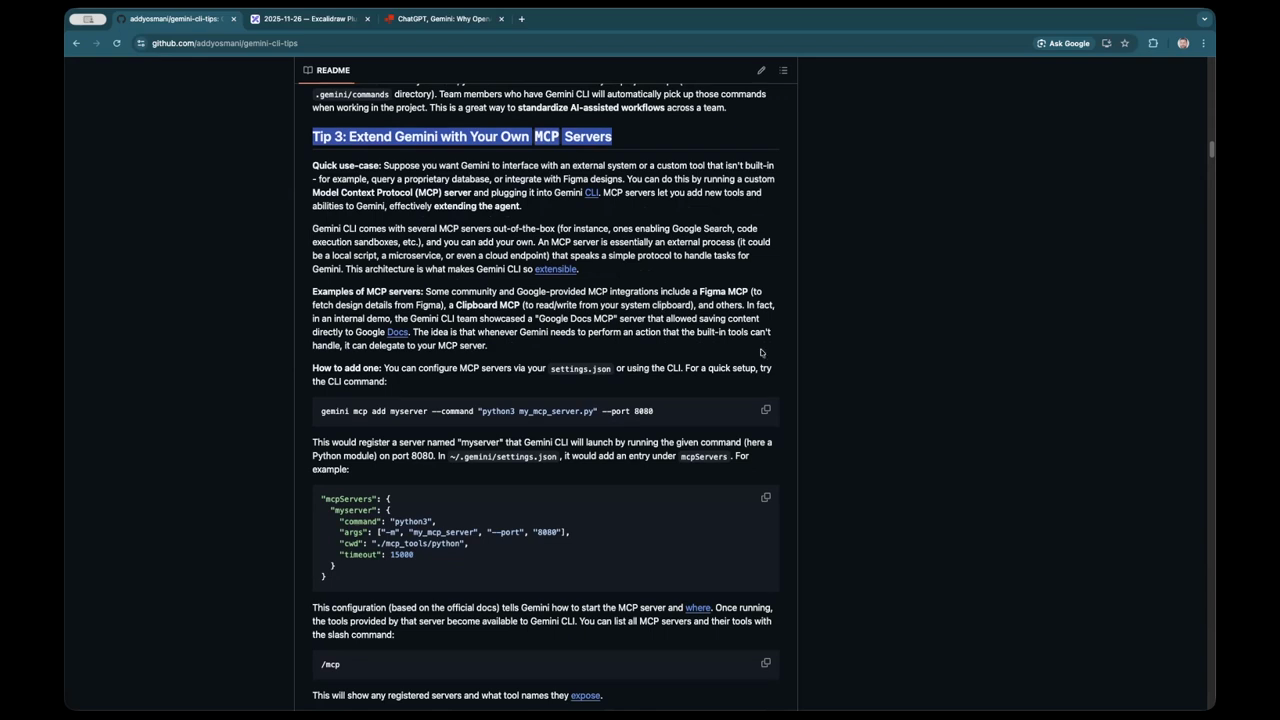
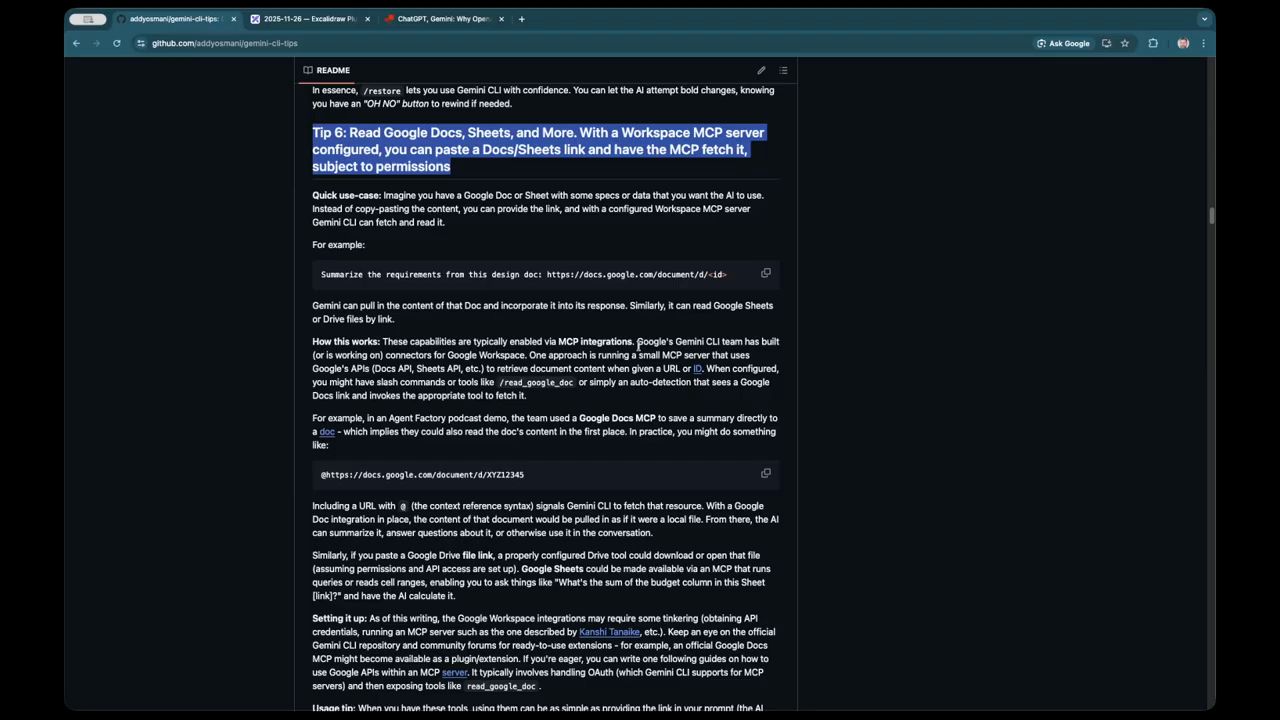
https://github.com/addyosmani/gemini-cli-tips
summarize "https://youtu.be/I4pmTz8EKag" --timestamps --slides
Two developers discuss the evolving landscape of AI-assisted engineering, focusing on the practicalities of managing multiple high-cost subscriptions and the technical shifts in model behavior. They explore the transition from simple code completion to complex agentic workflows, debating whether the current reliance on these tools constitutes an addiction or a necessary evolution in productivity. The conversation provides a deep dive into infrastructure troubleshooting, the nuances of different model architectures like Opus and Sonnet, and the emerging Model Context Protocol (MCP) ecosystem.

The rising cost of AI infrastructure
The financial burden of maintaining a modern AI development stack is becoming a significant consideration for individual engineers. One speaker notes that their monthly spend on the Claude API alone reached $80, a figure that surprised them given they were also paying for other services. When aggregating various subscriptions—including Anthropic, ChatGPT Plus, and Gemini—the total monthly “AI tax” can easily exceed $100. This is compared to traditional cloud infrastructure costs, such as a personal AWS account which might run around $30 a month for learning and hosting small projects. There is a growing concern about whether these costs should be absorbed by the individual worker or the employer, especially as the tools become indispensable for daily tasks. Despite the high price point, the speakers agree that the boost in motivation and the ability to plan complex projects makes the investment feel worthwhile. “I do feel energized and motivated to get things done with the help of AI… it really really helps at least me.”
Troubleshooting complex cloud deployments
AI has moved beyond simple syntax suggestions to helping solve deep infrastructure issues, such as debugging slow package installations in specific AWS regions. One developer recounts a scenario where a Postgres installation on an EC2 instance in Singapore appeared to hang for ten minutes during a Packer build. By using AI to generate debug SSH keys and monitor the process, they identified that the delay was caused by slow transfers from universal Debian packages. The AI suggested using local mirrors but cautioned that not all mirrors support ARM packages. This led to the creation of a custom latency checker and validation script to find the most efficient, compatible mirrors. This process highlights how AI acts as a force multiplier, allowing developers to build specialized tools on the fly to solve transient environment problems that would otherwise take hours to manually investigate.

The decline of manual plan mode
There is a notable shift away from using the built-in “Plan Mode” in certain AI tools due to concerns over accuracy and model behavior. While planning was once a core part of the workflow—creating detailed multi-phase to-do lists before editing files—some developers now find it detrimental. The primary complaint is that models sometimes deviate from the established plan or change logic mid-stream, leading to inconsistencies in the overall design. Furthermore, discussions on developer forums suggest that newer model iterations may be using sub-agents to explore codebases and generate summaries to save on token costs. This orchestration approach can result in less accurate plans compared to a model that reads the entire context directly. As a result, some power users are moving toward more direct, file-specific instructions or using specialized kits that boil down changes to individual files without the overhead of a separate planning phase.
Navigating the extension and subscription maze
The current AI ecosystem for developers is a complex “maze” of VS Code extensions, CLI tools, and varying subscription tiers. Engineers often find themselves juggling multiple plugins to access specific model features, such as the ability to paste screenshots or refer to local files more effectively. A key technical distinction discussed is the difference in context windows; for instance, some VS Code integrations may only offer a 65k token context, whereas using the same model through a dedicated cloud API or CLI might provide up to 200k tokens. This discrepancy forces developers to choose their interface based on the complexity of the task. Additionally, there is the challenge of managing personal versus corporate accounts, as using a personal subscription on company source code can raise security and compliance issues. Developers must constantly evaluate which tool provides the best reasoning capabilities for a given task while staying within their usage limits.
Agentic workflows and text-based triggers
The evolution of AI tools is moving toward “agentic” behavior, where the model can autonomously spawn sub-processes to complete tasks like exploring a codebase or merging pull requests across hundreds of repositories. One speaker emphasizes a preference for text-triggered agents over traditional UI buttons and menus. In this workflow, a simple prompt can trigger an “explore agent” to find applicable code patterns without the user needing to click through a specialized interface. This shift requires a process of “learning and unlearning,” as developers must adapt to the non-deterministic nature of these tools. Improvements in tools like the “ask user input” feature allow for more seamless interactions, where the model can automatically submit single-select questions to keep the workflow moving. The ability to use agents for bulk tasks, such as managing dependencies across 300 repos, demonstrates the massive scale at which these tools can now operate. “It’s about upskilling myself, building something real, not just like a toy project.”
Optimizing token efficiency with MCP
The Model Context Protocol (MCP) is a central topic of discussion, particularly regarding its implementation in tools like Playwright for browser-based testing. There is a critique of current MCP designs that send the entire conversation history back and forth for every individual browser action, which quickly exhausts token limits and leads to “horrible compacting” phases. A more efficient approach involves using models that can chain multiple tool calls into a single execution script. This allows the model to run a full trace, capture screenshots, and analyze the DOM tree (represented in YAML) in one go, rather than step-by-step. By generating a script to execute the entire flow and returning only the final result or error trace, developers can significantly reduce token usage. This method is seen as a major innovation in newer model releases, making them more cost-effective for complex integration testing and live troubleshooting of web applications.
Model: google/gemini-3-flash-preview
Transcript (auto-generated from YouTube captions)
I was going to I was going to show you
something here.
>> Yeah.
>> I got a I I contacted my employer saying
like
I can't see how much I'm spending. It
says you're on the you're seeing the
free plan because I'm using the cloud
API.
So if I go to settings usage.
Okay. No, I guess. So yeah, long story
short, I'm I've used $80 this month.
>> 80?
>> Yeah. Is that good?
>> That's a lot more than me, bro. You
always keep saying, "How can I use so
much AI credits?" And now you're using a
lot more. [laughter]
>> So if I But I I'm pretty sure that I
looked at Claude yesterday. You talked
about trust and um about trusting the
code. Now you have seven, but that's
your VS Code spend. That's different,
right? That's not your cloud.
That's GitHub. Yeah.
But how much?
>> You have no budget.
>> But still, it makes it look like I've
got 75% premium requests used.
>> I I just don't understand it. I mean,
how if I can't understand
how I'm spending money
on
AI? Yeah. So, it basically kind of
shocked me because if I'm like, if you
had to How much are you spending on AI
right now? Then
I pay Well, I'm always confused between
Singapore dollars and US dollars. I
think what I'm seeing is Singapore
dollars 30 for an entropic monthly
subscription. and I added another 30 in
my wallet with a $20 monthly cap. So in
total if I I spend everything I I I'd
hit 50 if it's in dollars 50 and then
and just just to
>> screen froze.
>> Yeah, it's frozen for me too. Hold on.
Let me see if I can just switch to my
>> You're in a
>> FaceTime camera.
>> Funny pose.
I I like to use the my my uh my phone
because the quality is so much better.
>> Okay. That was 50 on Antropic, right? Um
when you
>> Yeah. So, sorry when I said you spend 80
is more than me. I did not take into
account Chad GPT and uh Gemini U
subscriptions.
>> So, you're spending you're spending like
100. The the scary thing is is like I'm
like if if my employer said, "Oh, Kai,
you're spending too much on Claude.
We're not going to finance your $80." I
feel like it's the same thing with AWS
because I have my own AWS account just
for like learning and doing things.
And that cost me like 30 bucks a month
because I can't get it lower than that
because I've loaded up with some S3. So,
I'm just I'm I'm a little bit worried
that as a as a worker that I have to
take on these costs and like my wife
like bemonones me about our Netflix and
all these other subscriptions if if we
all if if I have to maintain an AI
subscription of 100 bucks a month. I
mean, is that is it's a bit annoying,
but I guess it's worth it. But,
>> bucks is Yeah,
>> 100 bucks is something but like it's
worth it. I mean I do feel I do feel
energized and
>> and motivated to get things done with
with the help of AI you know never mind
it like completing my code like the
planning everything it really really
helps at least me
>> never mind it also taking on a funny
thing right I was installing posgress on
an EC2 instance in the Singapore AWS
region and it was taking a very long
time it looked like it was hanging I was
using a packer build script right
supposedly completely finishes in 15
minutes but just adding Postgres now it
was like hanging for 10 minutes before
it even like finished the Postgres
installation which I put early in the
installation process [gasps] and after
troubleshooting it with AI for a while
it just said well you know we looked we
we signed in we had package generate a
separate uh debug SSH key so I could log
in to see to monitor the progress and we
we concluded that the the transfer was
just slow because we're downloading from
like universal DBN packages and Um, and
so it suggested a couple of mirrors, but
then we had to validate because the
machine was ARM and not all mirrors
support ARM packages.
>> And so it did some latency like we ended
up writing a latency checker for the
several um Singapore
>> mirrors available for like DBN ports or
whatever. And I ended up with like um
and and then there was a an edge case
where one of the mirrors maintenance
page show that they were no longer
supported but according to the benchmark
results had like a sub millisecond
latency which turned out to be a treat a
redirect to an error page and so it
didn't validate the the actual binary
contents of of the package that was
supposed to be there. Right. So it just
Yeah. So it it responded 200. Okay. But
the actual contents of the index was an
error page.
>> Yeah. So, so then we ended up with like
a whole a whole script to validate
mirrors for Ubuntu package for DBN
packages that are ARM compatible. Uh
well, any compatible because it checked
the architecture of the of the u of the
the kernel, right? So, so just to say
like yes, AI is so exciting, but as part
of my process, I ended up writing a
benchmark script for [laughter] the
Singapore.
>> Yeah, you get nice little surprises and
bonuses and and all sorts of artifacts
out of it.
Oh my gosh. So,
>> finished.
>> I want you to pick up on with on you on
the um
Sorry, I lost my train of thought. I'm
just I'm just I'm just kind of like I
don't know. I'm just like [snorts]
>> It's too early.
>> Yeah, it is a bit early. Yeah. I'm just
thinking that like how how much is AI
worth to me? It's like it's now just
it's now undeniable. I cannot live
without it. I'm just a little bit sad
about it.
>> It's funny because originally I had like
these these talks and panel discussions
and everyone agreed like we we we do a a
Friday, no AI Friday to make sure that
our muscles are still being exercised. I
haven't even thought about that in the
last four months to consider no AI
Friday cuz [sighs]
>> are we are we addicts? Are we I mean you
talk about your supply all the time. I'm
talking how I can't live without it. Are
we
addicted to AI?
Sad is it? I don't think it's sad. I
think the amount of output and I don't
think it's illusionary output as well. I
think it's real output. there's a 100%
sure that I couldn't do what I've built
today without the assistance
uh and also the motivation that it gives
you you know because no matter what you
come up with it will come up with like
something that looks plausible and once
and then some cause fallacy once you're
down the the road you just persist until
it's there and then you need AI to get
you out
um yeah but but when I was saying costs
for AI and I think like entertainment
subscription is similar Right. Actually,
like my chip is the good thing about
OpenAI is it's completely shared with my
family. Maybe it's not good that my son
is using it all the time because he's
literally giving like verbatim
assignments like here's a story analyzed
for literature like
>> yeah I got I got my wife using Claude
>> and she
the interesting thing she said yesterday
in the car [clears throat] was that she
wanted to cancel it but then she said to
me because I think Gemini does the same
thing but then I asked Gemini a question
and it completely messed it
and Gemini got it really right. Um, and
Claude got it right. So now I'm thinking
I shouldn't cancel the subscription. I
was going, "Yeah, maybe you should keep
Claude."
>> I subscribed Gemini last month when I I
was I think it was a bug with OpenAI
when they did the release. That's it
showed like that you had used all your
budget at some point. It displayed that
all the time. So, I was out of Codex
and cloud and I was like, well, I really
want to like continue and I was hoping
betting on Gemini 3 coming out anyway.
So, I was like, I might as well, you
know, subscribe to that while I'm at it
with the intention to cancel it if it
wasn't worth it. And I think I should
cancel it
>> Yeah. But it's the same thing like I
have Netflix, Disney Plus, and Amazon
Prime. I mean, honestly, Amazon Prime is
very small amount.
>> Mhm. Um, and and
>> yeah, yeah, Amazon Prime is the
cheapest.
>> Yeah.
>> Yeah. And yeah,
>> Disney Plus, I think I want to cancel it
because the most expensive and honestly
the output is so bad.
>> What What about cloud services like like
AWS? I mean, you must have like a $30 a
month type thing that I do.
>> Oh, yeah. I um I do have an AWS account.
I think it's something around that. I
have a CDM for the project which is
backed by static S3. I have no like it's
all serverless. I don't even use
lambdas. It's all static basically. Um
just the route 53 uh the TLS like the
certificates.
Um but the TLS is free, right? But it's
also the
uh what's it? Well, the CloudFront
distribution itself. Uh what else? uh
the the the route 53 like domain
registration because I do have some
domains via namecheep but I think it's
so much easier to just go through AWS
and like the cost difference make it
like
building
>> account I guess the $30 a month I mean
I'm aggregating it but it's because I
maintain
you know eight domains that I've never
really used in my life but I still pay
for them because I'm an idiot. So this
this this topic will be like how to like
all of the useless stuff we pay for.
[laughter]
>> Yeah, something like that.
Um, sorry, I'm still trying to gather my
thoughts. There was something I wanted
to chat to you about. Um
yeah, you you mentioned that like
switching to plan you you don't use plan
mode anymore like I I
>> so so because planning is like under the
spec kit where it creates a detailed
multihase and then boils it down to each
individual file exactly what needs to
change.
>> Oh this is because you spec it right?
You don't need plan what you're saying.
So now if I like initially when I did
that I went into cloud and as usual fire
up plan mode to create like a bunch of
to-do items and then read the spec but
what I found is that cloud sometimes
just changes the plan like even though
the task description are clear this is
what you need to do in this file and it
just goes and does something slightly
different and then in the overall design
things don't work anymore. I I've seen
cloud do that. So I'm actually now cloud
code plan mode is detrimental to my
>> that doesn't sound good at all.
I'm I'm plan mode. I'm plan mode all the
way, man.
>> That's why you start, right? But I've
also the reason why I sent you that
message is because I saw two or three
threads on Reddit uh yesterday because
with the new Opus 4.5 release, they also
revised the way plan works and they said
for Opus even it's worse because now OPU
spends up spins up sub agents and then
works off summary results and as a
result doesn't get like as good a um a
plan anymore. So people are complaining
that
>> is like a a better planning model, isn't
it?
>> Yes. But it spins up sub aents to
explore the codebase and then works off
those results which are inaccurate.
So if if you were to use Opus, which is
a more expensive per token cost,
>> you get more you get other things you
don't want with it. Is that is that what
you're saying?
>> No. No. If you were to use Opus, which
is like very more expensive per token,
uh it would itself read and understand
everything and then make a make a plan
out of it, right? But because they're
trying to save cost, they are like
having Opus more as the orchestrator
spinning up sub agents that go and read
things then create summaries and then
feeds that back to Opus. As a result,
those summaries are not as accurate and
Opus makes incorrect plans. That's the
complaints that I read on Reddit um
today and and I was like actually it's
not a problem for me because I'm not
even using plan mode anymore. Even
before the update, I already noticed
that there was something wrong with it.
>> In in your screencast you you shared
with me there's something else that I
didn't quite understand or I haven't
seen before. You using anti-gravity, I
guess, right?
>> I'm using what? Sorry.
>> You were using anti-gravity.
>> Anti-gravity. Yeah. Yeah, there was this
workflow thing that I had.
>> Yeah, but like you were choosing there
was an option down by the model where
you were choosing if it was like
>> Oh, that's high, medium, or low
reasoning or something.
>> Oh, that's a that's a Codex plugin. No.
>> Oh, can you just show that? Like what?
Why? Why would you
>> twiggle that toggle?
>> Uh, which one is it? This one.
>> Yeah. Can you just zoom in down there?
So to see your
>> how would I zoom in? I can do this. Is
that zooming in?
>> Um Oh, I thought you might use the the
Apple zoom which is like I don't know
what I think you have to enable
>> but you can read it, right?
>> Yeah. Yeah, it's good. But
>> the setup is to put on your VS code your
chat window on the right on this right
sidebar.
>> Yeah.
>> And by default you will get your co your
Visual Studio Code
>> um here. Right. And you can choose
Codex. Yeah,
>> those are the ones that you get with
your your co-pilot subscription.
>> Yeah, and I'm locked into 4.5, that's
for sure.
>> I mean, um,
>> and then
>> I have installed another plugin here
which is called Codex.
So, I have the the Claude Code plugin,
but I also have the Codex plugin, the
OpenAI Codex. Where is it?
>> Yeah, it was up the top there. I think
it was at the top. Uh,
>> this one.
>> Yeah. So when I I started using Codex
through this CLI um it was horrible
because you couldn't paste screenshots.
It was really bad compared to Claude Code
right. So I installed this plugin and
here you can put images you can easily
refer to files things that the CLI don't
really has properly and down here when
you select the model that's where then
you can now access with your I have chv
plus right $20 a month I can access now
in my VS code through that subscription
GPT 5.1 Codex with high reasoning I
think it's a promotion they're trying to
see how well the model does
>> I don't understand why why couldn't the
the co-pilot chat expose 5.1 C Codex
max. So this is something also I just
read on on uh on Reddit the other day
was people asking like what's the
difference between running Sun 4.5 here
and running Claude Code son here in the
in the terminal I can run them both
right and one of the comments and I
don't know if this is verified said that
the context that VS codeense is much
smaller 65k tokens instead of like the
200,000 tokens that you get um in in
Claude Code so so that's why they are
able to offer for these at like 1x
within your VS code copilot subscription
because they're not as effective.
>> Yeah, but we I'm more I'm more u
concerned about your Codex one, not
clawed. Why why why can't you use Codex
max in your copilot chat? Why do you
have to install the Codex uh
>> because it's a different subscription?
>> But isn't Codex OpenAI
and isn't and that's owned by Microsoft
pretty much. But I'm paying it's
different if you pay Microsoft vs code
and OpenAI is still its own its own
entity, right? They have a partnership
and an investment.
>> Oh, I see. I thought I thought there was
I I assumed there there'd be some really
tight integration
>> because
>> you know Microsoft is a customer of
OpenAI like a partner and they get
access to some models
>> because because it is a bit of a like a
maze to I mean you must spend half your
day working out which extension, which
optimization,
which thing to to use to get the best
out of your subscription. It's a
nightmare if you're like a if you're in
like a corporate environment, you know,
I'm not I'm not even allowed to install
the extension. I think uh
>> uh corporate environments I'm not
talking about and I'm on a corporate
laptop actually, but luckily they have
not locked that down. Um and this VS
Code subscription is through the GitHub
organization. I I I used to have my own,
but I canceled it. Uh and then the
company has seats, right? Um so this one
is controlled by the company and okay
and it can see how much each of us is
using. This one is my personal Codex
which of obviously if I work on company
um source code that would probably not
be acceptable that I am using my
personal Codex with like the open eye
uh plus subscription versus the VS code
agreed
um like you know part of the GitHub
organizations we discussed.
>> Yeah. Um,
>> I'm just using the chat. Um, but also
then you have you need to learn how to
set up your workflow. I installed this
Codex plugin the moment they announced
it. Like, hey, we have a Codex plugin
and that's it. Like, I added that in. I
saw that I could paste screenshots and I
was like, hey, let's, you know, I like
that more. And I go between the codec
cli and the plug-in however I feel like.
And like I said, most of my workflow is
Claude Code. Um, but then sometimes
because I look at my usage here and I
say, "Oops, I'm close to my weekly or
whatever." Then I start like, "Can I not
do some of these task with Colex
instead?"
>> Yeah,
>> I think maybe it was maybe it was like
some sort of FUD, but I saw I saw a news
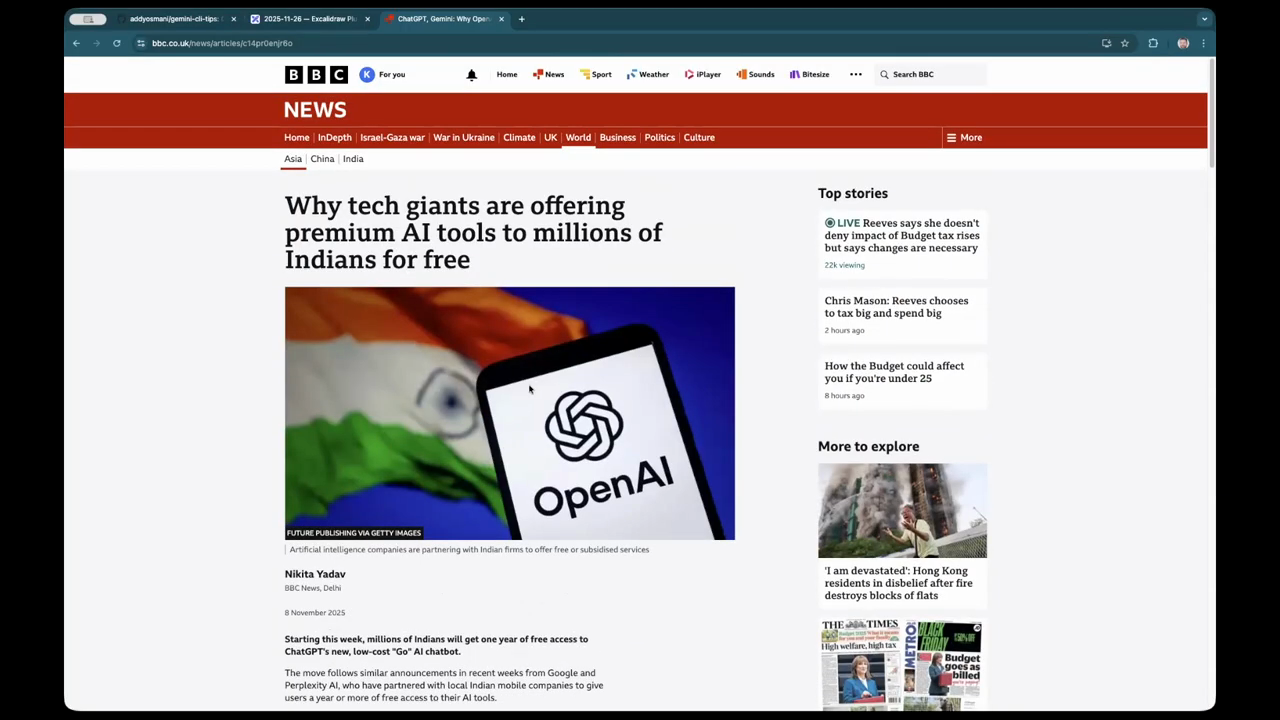
article or tweet that that evidently
Open AI is giving
free AI open AI to to India or something
crazy. Did you read that or am I just am
I just racist? [laughter]
>> Pl the sixth on both or is it the fifth?
[laughter]
Uh no, but um that would mean that if I
re answer it, incriminate myself. That's
not what I meant. But anyway, [laughter]
oh yeah, I found it. I found it. Um, I
mean it's not being I guess I I mean I
think it's a little bit unfair to offer
a whole country something that we
ordinarily have to pay for.
>> Well, how much of you how is your salary
compared to I don't think it's unfair.
>> Oh, for Christ sake. You're going to
Okay. So, whole India gets open AI.
>> Why not? [snorts]
>> Um,
okay. As long as it's confirmed that
they're in India. [laughter]
You have to cut that out.
>> What do you mean? As long as it's
confirmed.
>> No, no, never mind. I didn't say
anything.
>> I mean, you should move. I mean, I'm
just thinking that like in in the in a
dystopian future that that Vincent moves
to India just because he's addicted to
his uh codec subscription and this is
the only way it can be sustainable.
I don't see it as an addiction. It's
more like an ambition. An ambition of
Yeah. It's about upskilling myself,
building something real, not just like a
toy project. And and honestly, I often
ask myself, why do I spend time on doing
this when I could just, you know, do my
work and then go to the beach in Vietnam
and kite surf, you know? So, so it's
more our ambition because how much like
how much time do we have left to um to
realize? Yeah. Yeah. Yeah. That's one
thing. I mean, moving to England two
years ago has been a huge culture shock
to me because there's a lot of people in
England and probably Europe who work
like 4 days a week. I'm like, dude,
you're in your you're in your freaking
prime. It's your it's your obligation to
your family and to you to work as hard
as possible to maximize everything so
that you can you know retire early if
anything and then
>> retire with a broken back and inability
to walk properly anymore and not enjoy
the time with your kids. I mean there's
a there's a there's a good reason why I
I I really like um Scandinavian
countries when I work there because
>> Oh no. So you're going to tell me no. we
actually should be working four days a
week and that's why we use AI.
>> Uh
I mean I'm saying that right. It's a
flip coin because when COVID finished I
know so many of my friends from
Singapore who were cooked up in you know
at home decided like that's it you know
I'm I'm not spending my life working.
I'm going to go travel for the first
year. Some of them took a sabbatical and
then all the tech layoff happened and
then half of them couldn't find a job
because the market was saturated.
>> So what are they doing now?
>> Your friends
>> panhandling in Bali.
>> So So the So on one side I I'm saying
you should spend your youth with your
children. You should you know you have
to balance it like work life balance
even though it's your prime. But I'm
saying that and I'm doing the opposite,
[laughter] right? I'm up in my bed on
on, you know, doing system design
specifications from my phone uh or while
I'm having a coffee outside. Um and I'm
not spending enough time, you know,
doing the things that I can enjoy right
now. Um so yeah, I'm not consistent.
>> Yeah, it's a difficult topic. the um
there's a guy that I've been following
for years uh Eddie Osmani. He's he's big
in the web world and I used to be big in
the world. I don't know if I used to do
stuff for the W3C and and browser
engines in the beginning of my career
and I think I'm come across Eddie Osmani
then
and he's still around.
He's he's like a a lead at Google and he
wrote an open he wrote an AI book or
something.
>> I think I saw I follow several Gemini
CLI like core team members to find out
if they are doing some improvements to
the product and I think I saw somebody
share this like uh Gemini CLI things as
well which I was like I'm going to have
to look at it but then
I mean most of these are like oh this is
>> yeah I know about that. you know about
that. This is like use Claude
>> create custom commands. I mean this
>> create custom commands. Okay. Yeah. Yep.
We know about that. I I to be honest I'm
not as I pointed out yesterday I don't
like things polluting my command space.
I'd rather use um
the way that Claude the way that you
trigger an agent or a skill in Claude is
just by text
but via the prompt and it works
reliably. I I I never get the feeling
that oh no it's not triggering the right
MCP or
>> that's the weird thing about using these
tools is that we are used to find menus
and buttons to click on
>> whereas right now in words we say
something and that kind of triggers the
LLM to more like oh
>> and you can see that it triggered it.
>> Yeah. Yeah, but the thing is like they
have this thing of agents, right? But
you don't really know like, oh great,
there's agents. And sometimes it's like
decides to use it. But you can actually
just say like, oh, by the way, you know,
send off uh an explore agent to go
through the codebase and find wherever
this might be applicable and it just
spawns an agent and does that like
there's no button to click,
>> right?
>> Yeah. Yeah.
>> What's the words that I use to trigger
>> me? At one time I I used agents to
depend a bot merge everything in my in
my 300 repos. It worked really well.
Um, but I I want to kind of tie it into
that because I shared with you something
that I saw in the change log of cloud
code and they said they improved the ask
user input tool and I was like oh so
that's the thing it's called it's like
ask user question tool to autosubmit
single select questions on the last
question and so
>> right so so when I saw the name of the
tool now I suddenly like have maybe like
son will know that if if the user
says something or ask me a question
about this, it will automatically change
>> so you know how to use it. Yeah. Just
>> there's a lot of learning here like just
to know when an agent is spinning
knowing that you're you you can you're
in plan mode so you can get the prompts
knowing the dialogue for an MCP call.
>> There's a lot of learning and
unlearning.
>> Okay. because I saw somebody on Reddit
complain like the latest update on the
plan mode behavior has broken my
workflow. And I'm like, yeah, who cares?
I mean, that's part of of of of your
job, not only to know how to phrase
things to trigger the behavior that you
want to see in the model, but also
realize that that behavior is no longer
the most efficient and change the way
that you prompt a model.
>> Yeah.
>> So, learning and unlearning, which is
why it constantly changes. [snorts] You
know, I can see some people struggling
with this. I mean, I can see some
Anyway, so tip three, use your MCP. We
all know about that stuff.
>> I think struggling because of the
non-determinism, right? Because
supposedly everything is perfect and
when you say something, it's going to
act the way you expect it to work. Yeah.
The problem is like what I just noticed
here. It's triggering on the tabs being
in in the Golang file as an indentation
and then it's it's update tool not
working and then it's it sometimes goes
to our I'm going to do an here do with a
cat or I'm going to use Python to update
the file. Like what? Stop stop.
>> Yeah, I I mean I can see some people
struggling. Maybe I'm just belittling my
some of the people I've come in contact
with, but uh but I can see [laughter]
>> be very specific.
>> I can see some people struggling, but
maybe maybe it's a skill we can all
learn. Okay, tip four. I think that I
think leverage memory addition. So I
think I'm I'm when when someone says
memory, I'm thinking beads already.
Do you use do you use slashmemory
>> and used to be with a hashtag to just
update the cloud MD file I think but
they might have changed that. So the
thing about beats is exactly the thing
like before right at some point if cloud
code shell is so much better than beats
I must be able to get rid of it quickly.
So if if if it's tricking up my LLM more
than it's helping I need to be able to
remove it right.
And regarding memory, I mean I remember
when a long time ago you would say
something like uh please remember to do
this always. Then it it would
automatically pick that up and feedback
like hey if you put the hashtag it will
automatically write it to the cloud MD
file and then the slashmemory was
supposed to be something similar but
maybe they've updated it, right? I don't
know that.
>> Yeah.
>> And and this is for Gemini, right? This
is not for Claude Code.
>> Check restore as an undo button. Um,
>> that's also again is just a double
escape.
>> Oh, yeah. Yeah. Then you get the menu
and you can choose. Yeah.
>> I use it a few times actually. It's I
love it.
>> This applies to Claude. Uh, well, tip
six it read Google Docs.
Um, I think Claude Claude Claude desktop
could do this. I noticed that it
integrates quite well in my
>> actually Opus 4.5 has been significantly
improved around um doing those
multiflows where it goes across
documents. I never do that because I do
coding task and I don't have to deal
with Google Docs but a lot of the
entropic examples on their blog post
related to Opus 4.5 is the token you the
token usage effectiveness of Opus 4.5
when doing these tasks. Um, and
>> the whole MCP drama that is now because
Entropic created it and now they're
saying, "Well, we don't do MCPS like
that anymore." You can actually hint on
your tools um with information about how
to use the tool in a script so that Opus
will write a script to use the tools to
then execute everything in one go.
That's one of the things like I I joked
about yesterday with like on Facebook
was like everybody wrote these MTPs with
all these tools. Now you have to go and
update them all because now you have to
go and indicate how to use that tool in
a script for
>> open. Yeah, I saw your I saw your
LinkedIn thing.
>> Yeah, the the we talked about playright
before, but every time I use playright
at work, the the token limit gets gets
exceeded and then it does that horrible
compacting uh phase which I've now
turned off. So I don't know what's going
to happen now that I've turned it off
thanks to you. Does it just stop?
The thing about MC about playright right
I think this MCP server is is is wrong.
It's not good design because
>> it's like one of the one of the what do
you call it flagship MCPS but carry on.
Well, to me
after after adding playright scripts to
my my you know my API with a with a web
app to go through the flows user flows
you know login get redirected to
keycloak um sign in get back to the app
then validate that you can do this but
not that if depending on your group
membership and things like that these
type of user flows very hard to test
with uh integration testing golang or
something like that right because you
need to parse the respon from keycloak
to find the the the session token or the
whatever it's complicated. So um after
building those playrights flows I was
really impressed with pay playright
because what you get is a full trace of
screenshots context like this is what
what the it has like this YAML
representation of a web page of the tree
of the like the DOM the document object
model of what are the different elements
and how they're nested and what their ID
>> how do you see this YAML does it spit it
out
>> you see it also if you if you use the
dev tools Chrome MCP when you're doing
like you wanted to investigate some
problem in your web app, it can launch
Chrome, which is way lighter than the
than than the than Playright itself
because Playright requires a plug-in,
but Chrome can run on its own with the
Chrome MCP. So, I like that one. And it
can launch it and then the LLM will say,
okay, I take a snapshot and it shows you
like a YAML document tree. And then when
you uh when it sees like let me check
the response from the API server. It
goes to the JavaScript console in the
browser and runs a small script that
uses the React app state and um does a
query like hey I have this session token
and everything and then boom it it does
the query from within the console which
is way more powerful than what you can
do just within the terminal right so so
this type of actions amazing for like
live troubleshoot yes it's going to eat
your tokens and I think they [snorts]
made some as well
>> I use playright with a a brow an
existing browser so that has all my
tokens and all that stuff I But then
what I what I think the mistake is of
this MCP a playright MCP server to drive
a browser which is like send the message
uh to the browser get the response then
send the whole conversation to the API
to then generate the next step which is
your context window then send a message
to the browser get the response append
it then send the whole thing
>> I agree it's a it's a nightmare it's a
nightmare
>> right so what I think makes the most
sense is like the execution logic of
opus which is you have a stra a trace
you kick off the playright flow and and
actually within the playright browser
window you get that next to the error
where it happens like hey I'm supposed
to see this button but it's never
visible and I time out then it gives you
like this error and you can click uh
copy prompt and you can paste it into
into your model and it says like you are
working on this problem this is the
playright test this is source file this
is the this is the snapshot of the
browser context and this is the error
message that that that we're stuck on
and then the whole context is there.
That's like much better than like do
this then do this, then do this, then do
this, do this, and send the conversation
over the whole time. You get the whole
flow and you know, you run through it.
That's exactly the idea of Opus, right?
You run through a process. You put the
>> So, so wait a minute. Is this a solved I
don't really understand. Is this a
solved problem with with Opus or is this
>> Yeah, the the big innovator of Opus is
that it identifies like how to chain
several tool calls and then run them and
then get like send
>> I need to I need to try this. I'm
struggling.
>> So that's why they say Opus is way more
token efficient. Opus 4.5 is way more
token efficient and bottom line cheaper
than Sun 4.5. So if you can if the model
can really be efficient with its tokens,
but it has to fit the use case. I think
>> I thought we started the conversation
saying that the playright MCP sucks. So
it the playright MCP can just stay as it
is and Opus can basically compensate.
>> The playright MCP is the wrong tool
because it's going to send your
conversation across every time the whole
context window, right? It's going to do
an X tool execution, get a little bit
more appended to the context, send
everything over and then send back uh
response tokens appended.
>> But how do I set up?
>> So MCP server is bad. The actual ability
to run traces and capture the trace is
good because that's the concept of a
full execution and get the result of
that execution, not do every individual
call and send the conversation over
every time. You see the difference,
right?
>> Yeah. But what are what are my practical
steps to get my playright flows more
efficient then use opus?
Uh
well so what you said earlier was kind
of correct because you said like opus
will fix it because it should be able to
change the chain those MCP tool calls uh
and then do the whole flow and get the
output. I have I don't know that. But
what I do know
>> is I got to have a play
>> the playright uh tracing capability and
using the MCP with current model doesn't
doesn't work that way for me. Okay.
>> But it would be interesting to know if
if OPUS is therefore like what you said.
So Opus solved that. Right. Maybe it is
right.
>> Let's let's let's carry on looking
through this thing. Do I I to be honest
I don't use the ad symbol anymore
because every time I press it it
launches UI. I just I just paste the
relative path.
>> Is this for Gemini?
>> Yeah. But I think the same works this
works in Claude I think.
>> Yeah. Yeah. Yeah. But in cloud it just
like drops down the file list and then
you just tap complete the file and then
it kind of like sends the
>> I'm used to like copying relative path
from VS Code and just pasting it in. So
for a while and I'm not sure who I think
it's Gemini doing this when you relative
copy relative path when you paste in
Gemini it adds the add some symbol on
its own.
>> Oh really?
>> In the in the Gemini CLI. Yes. So if you
copy a relative file it actually like
creates it as include this file in in
the in the in the query because you're
going to need it anyway which I don't
fully agree with. Sometimes I I remove
the ad sign and I say and go through
this file bit by bit if you need it like
search for these strings and then go
through it. I don't want to send the
whole file, right?
>> Uh
cuz I have a feeling you're I mean this
to me here is an anti pattern because
like
>> the minute I do something like this I
feel AI is just going to do some really
crazy answer. Like I feel like some
people,
okay, I'm not I'm not trying to I'm not
trying to I'm not trying to like
identify my my colleagues, but some
people don't know about diff
>> and it's kind of scary
>> and like they should be using diff to
see the changes. They should not be
doing something like this.
>> I I was going to say the biggest problem
there is the extension. It's it's a
Python file. [laughter]
>> Okay, next. On the-fly tool creation.
What the hell is that?
Um,
>> don't know. I don't know what that Do.
You know what that is? Sorry, my
mother's up. It can use its coding
abilities to fabricate new ones as
needed.
>> Oh, I think I think I think it's like
creating
Oh, yeah. Like in in
>> write a Python script to parse it. Yeah,
like Claude skills has this has this uh
>> directory where you dump in scripts
which can help it do its thing. I think
it's it's alluding to that.
>> Yeah. And which is I think very valid.
Um which which is kind of like related
to the blog post again, right? Where
where they can they can create the
scripts to do the work and then you know
just put the pass in the input and then
see the output without having to you
know pass the full context across each
time. And so you save tokens that way.
Yeah.
>> Use Gemini CLI. Okay. It's just like
using YOLO mode. Okay. This is all
boring stuff.
I I never do things like this. I don't
>> I haven't but like
>> I know about it.
>> Speckit. I thought speckit had some
scenarios where it told inside the
prompt to say give me sub agent prompt.
Charlie.
>> Okay,
hold on. Oh god. Unfortunately, this is
the time I need to help my kids get to
school.
>> Yeah. Anyway, I thought thought it was a
good chat. Maybe I can merge the two
that we had and
>> Yeah, make it entertaining on some some
things.
>> All right. See you.
>> See you.